Showing posts with label Medal Of Honor. Show all posts

Thursday, June 20, 2024

Replay Review - Medal of Honor: Airborne [2007]

By 2005 there was a trench war going on in the World War II shooter sub-genre. Electronic Arts' original WWII FPS, Medal of Honor which first debuted on PlayStation in 1999, reached great heights, but during its run, games such as Call of Duty stole a lot of the series' thunder. EA took a different direction with Medal of Honor: Pacific Assault, opening it up with larger, wide-open spaces, giving choices to players, where there was simply a single trail before. Medal of Honor: Airborne took it one step further, offering players the chance to drop from airplanes into the battlefield.

As PFC Boyd Travers, a soldier in the Army's newly-minted Airborne division you parachute drop into combat from the air. Travers' war takes him through every major Airborne operation of WWII; his story is the story of the birth of the Airborne, which continues to help define American combat forces to this day. Airborne as a game was fundamentally about freedom and player choice. From the first step out of the plane, the player was in control of how the experience plays out. The player defined their landing spot, angle of approach, tactics and style throughout the game. It was a very refreshing difference to the single-path shooting galleries of shooter, of which many still exist today. Indeed the commitment to make a more choice-driven game required EA to change the way they designed levels, and the way NPC interactions were crafted. 

While the freeform Airborne mechanic and level design was welcome, the game sadly suffered for a near total reliance on it. The revolutionary feature was developed at the cost of nearly everything else that EA had been promising and teasing since the game's first announcement. Early reports included the inclusion of drivable vehicles (which had now been done in Halo and Far Cry) in the form of a Jeep and were so hyped up I even wrote about it here back in August 2006! Sadly by the time of release the game had significantly shrunk in scope and level size due to the parachuting preventing the logic of large enough levels that would benefit from drivable vehicles. 

The product that was eventually delivered was, in my opinion, a little disappointing when compared to both Medal of Honor: Allied Assault and Pacific Assault. I recall that I never purchased the game, I just borrowed the DVD-ROM and decided against buying it after. As I had a couple of days before my EA Play sub expired after playing STAR WARS Jedi: Survivor last month, I decided to take Airborne for a spin to try to remember why and properly document my experience.

Unlike Pacific Assault's excellent intro/tutorial, Airborne's was very poor. It only demonstrated parachuting down into different surfaces to get used to the mechanic but showed nothing else like combat or throwing grenades etc. While I certainly didn't need to be told how to play an FPS in 2007 anymore than I do now, the immersion of being in a training environment before going off to war that was so excellently captured in the previous instalments was a serious omission. The ability to chose your weapon load-out before starting a mission was and excellent feature but upgrades for your weapons were XP-based, mandatory and permanent upgrades to your weapons once earned and which for some were an unwelcome addition; especially the scope on the StG 44 forcing you to play the weapon differently for the remainder of the game!

With the exception of the first level, where you're shooting Italian Blackshirts, you're shooting German Nazi's. The problems I had with the shooting mechanics came back to me before long. Some Nazis would drop quickly but others appeared to be pretty tough. This is apparently not the case however - it was in fact an issue with accuracy, the player's accuracy was possibly coded as piss poor with some weapons and this reduced the 'joy' of shooting... in an FPS! Later in the game you also encountered a "Nazi Storm Elite" enemy, a huge figure in a black trench-coat and gas-mask able to hip-fire an MG-42! It was like something out of Wolfenstein's alternate reality as opposed to the normally reality-grounded Medal of Honor series and it was clear EA were a bit desperate at this point to include it.

The levels and objectives within them were nothing new, some were much larger than others but due to the way they were designed and the types of objectives you had (usually demolitions) each one took about an hour to do which was a long time for a single FPS level, the issue was there was only 6 levels in total. The first three levels were quite unremarkable, the fourth could have been excellent as was it was for Operation: Market Garden (with visuals that could have been from A Bridge Too Far) but instead of logically making it a sniper mission, you had to blow up a tank in the village below and kill German rocket troops up on a bridge! It wasn't until the fifth mission, in an industrial train-yard during Operation: Varsity that I felt the game opened up and was actually worth playing, that and the excellent finale where you landed on and subsequently destroyed a German flack tower in Essen, Germany were the only missions I recall playing originally, I forgot the others entirely.

Just three months after Medal of Honor: Airborne hit the market, Activision dropped Call of Duty 4: Modern Warfare, and the rest is history. Airborne despite having a revolutionary mechanic was still a jaded WWII game with less than stellar shooting mechanics, OK multiplayer an no real story or connection to its main character. CoD4:MW in contrast is credited as one of the greatest FPS games of all time. 

Final Verdict: Medal of Honor: Airborne is a disappointing substandard experience that's really only offers any worthwhile gaming in its final two hours. While it's a good two hours, they're not worth buying the game now.

Technicals: 6h 8m playtime though EA App in 3440x1440 @ 175FPS on RTX4070Ti in Windows 11.

Bugs: Weapons would occasionally disappear from view. This behaviour was corrected by applying VSync in the game's launcher. A stuck spot in the geometry of a stairwell meant a reload. Some minor instances of audio not playing.

Availability: Medal of Honor: Airborne is only available through the EA Store for €4.99. Review copy was installed at no extra cost from a one-month EA Play subscription in May 2024.

Medal of Honor franchise:

  • Medal of Honor [PS1] (1999)
  • Medal of Honor: Underground [PS1] (2000)
  • Medal of Honor: Allied Assault [PC] (2002)
  • Medal of Honor: Frontline [PS2/Xbox] (2002)
  • Medal of Honor: Rising Sun [PS2/Xbox] (2003)
  • Medal of Honor: Pacific Assault [PC] (2004)
  • Medal of Honor: European Assault [PS2/Xbox] (2005)
  • Medal of Honor: Vanguard [PS2] (2007)
  • Medal of Honor: Airborne [PC/PS3/X360] (2007)
  • Medal of Honor [PS3 / X360 / PC] (2010)
  • Medal of Honor: Warfighter [PC/PS3/X360] (2012)
  • Medal of Honor: Above and Beyond [PC - Oculus VR] (2020)

Tuesday, April 25, 2023

Replay Review: Medal of Honor: Pacific Assault [2004]

It has been more than three years since I went back and played Medal Of Honor: Allied Assault, as great as it was, this one Medal Of Honor: Pacific Assault is my favourite of the  franchise because it moved the action from the European theatre - where most of the U.S. campaigns of WWII shooters take place - to the Pacific and also put you in the boots of a U.S. Marine. This had been done the year previous with the substandard Medal of Honor: Rising Sun for the consoles, but Pacific Assault was the real deal and was generally far more well received.

Graphically Pacific Assault was superior, upgrading from Allied Assault's id Tech 3 to a modified Lithtech Jupiter (from Monolith Productions) with some additional Havok physics. It was released just shy of three years since Allied Assault and it represented a lot in terms of more modern FPS games. No longer could you single handedly "win" WWII by running and shooting everyone; here you had to take cover, aim your weapon properly and rely on your AI team-mates to which you could issue rudimentary commands for covering fire, intel on enemy positions/attack vectors and even healing. Now admittedly it didn't do any of these things brilliantly, the level of AI required to make this a seamless experience was a bit away yet but this was one of the first to do so and you have to start somewhere. That said it is a bit frustrating when your own men walk into your line of fire.

Let me say that the game's "training course" is also one of my favourite training courses in any FPS. It starts off with an appropriately loud drill instructor who waxes lyrical about his beloved Corps and how much better it is than all the other services. He then puts you through the paces of learning how to play an FPS in the decidedly Marine way: with live ammunition! One of the essential lessons you learn is taking control of a fixed weapon positions such as mortars and machine guns. The game is littered with mounted weapons of different types that you take control of, certainly more than any other FPS, so it's something one should get used to.

Pacific Assault's real draw was the different setting and not having to shoot another 1000+ Nazis during it's 11 hour campaign. The Japanese adversaries here were not just reskinned Germans either, they obviously appeared as Japanese soldiers, yelled in Japanese, used appropriate weapons and equipment and best of all would occasionally Banzai-charge you with their bayonets! Missions involved Pearl Harbor (1941), Makin Island (1942), Guadalcanal (1942-1943) and Tarawa (1943), the tropical jungles and golden beaches of the Pacific islands presenting a welcome respite from the bocage and hedgerows of France.

While the setting was one of it's greatest draws, it was ultimately a little too realistic. About half the game had you wandering through dense jungle  eliminating Japs in ramshackle wooden villages. While the objectives were varied with regards to gathering intelligence, eliminating radio towers, fuel containers or ammunition dumps etc. these took place in jungle clearings after a slow trundle though the surrounding foliage eliminating enemy patrols first. A very rinse and repeat cadence to it all - much like the USMC's war accounts from the period. It's not to say of course that the game is unexciting, just a little more repetitive than others of it's ilk and for many players it wasn't an interesting experience and certainly not whet they were used to.

While the Medal of Honor franchise took a more sombre, realistic stance than Call of Duty's more cinematic games, Pacific Assault still didn't showcase the brutality and sheer inhumanity of the Japanese which far exceeded the calculated the industrial genocide of the Nazis. It would have been a very different experience to have the player rescuing those captured by the Japs as opposed to Nazis (again). However as few allied POWs taken by the Japs lived to tell the tale, it would likely have been an unrealistic expectation for a game that of course must end on a victorious note.

Final Verdict: Pacific Assault allows you to experience WWII from a different angle for once, here the first half of the U.S. Pacific campaign. However it will likely seem far to bland to someone who may not have studied the war in the Pacific and a little substandard in gameplay/AI quality to similar titles due to newer concepts of the time. According to in-game statistics I personally eliminated 1368 Japanese soldiers as a Marine Raider, so I'm as happy with it as I was originally.

Technicals: 10h 37m playtime though EA App in 1600x1024 @ 91FPS (Engine cap) on RTX3070Ti/4070Ti in Windows 11. Windows HDR enhanced visuals.

Bugs: None.

Availability: Medal of Honour: Pacific Assault is advailable through the EA Store for €9.99 or GOG for €9.39. Review copy was obtained from EA Origin free givaway in March 2016.

Medal of Honour franchise:

  • Medal of Honor [PS1] (1999)
  • Medal of Honor: Underground [PS1] (2000)
  • Medal of Honor: Allied Assault [PC] (2002)
  • Medal of Honor: Frontline [PS2/Xbox] (2002)
  • Medal of Honor: Rising Sun [PS2/Xbox] (2003)
  • Medal of Honor: Pacific Assault [PC] (2004)
  • Medal of Honor: European Assault [PS2/Xbox] (2005)
  • Medal of Honor: Vanguard [PS2] (2007)
  • Medal of Honor: Airborne [PC/PS3/X360] (2007)
  • Medal of Honor [PS3 / X360 / PC] (2010)
  • Medal of Honor: Warfighter [PC/PS3/X360] (2012)
  • Medal of Honor: Above and Beyond [PC - Oculus VR] (2020)

Tuesday, July 30, 2013

A prophecy unfulfilled, Williams returns for Star Wars VII, but is this good?

Following the release of the score to Star Wars, Episode II: Attack Of The Clones in 2002 a like-minded score enthusiast friend asked me what would happen if John Williams had to be replaced for Episode III due to his unfortunate death or ill health [after all Williams was 70 at the time] and who could do his job? Despite it being unfathomable to such a die-hard fan like myself who has even made Star Wars the basis for his spiritual beliefs for anyone else to score Star Wars, I always have had my eye on the future and without any hesitation at all I offered a single name in response to his question: Michael Giacchino.

My friend laughed at me. To be fair, his reaction was not unjustified; at the time Giacchino wasn't even a 'name' among the film score community. Much like Jeremy Soule, Inon Zur and Bill Brown he was only known to video-game score enthusiasts as he was responsible for most of the scores for the Medal Of Honor franchise as well as the first scores for Call Of Duty. As great as all that music was for video games, there must have been over 200 top names in a movie-producer's Rolodex between David Arnold and Hans Zimmer all of whom would be far more experienced to score a motion picture than any video-game music composer, therefore my choice was branded as "idiotic".

But a lot has happened since then and now in just over 10 years Giacchino was put just a single step away from actually scoring Star Wars VII, turning an formerly idiotic answer into what seems now like a prophecy of biblical proportions.

Micheal Giacchino has now actually become one of the most prolific composers in modern cinema. He used scores for animated comedies like Ratatouille as a stepping stone to score live action pictures like the abysmal Speed Racer. He is praised for his work on The Incredibles and critics agree that his score is the only redeemable element of the otherwise woeful Land of the Lost.

Giacchino won the coveted Academy Award for Best Original Score for Up in 2010 as well as numerous Grammys, Golden Globes and has received additional nominations for Grammy's and Emmy's. As impressive as all these credentials are, they alone are not enough to put him even close to Star Wars VII, for that we must look elsewhere.

First of all Giacchino has a long history with new Star Wars/Lucasfilm overlords Disney. Originally he worked at their publicity department in NYC, and then LA. From there, he went over to Disney Interactive as an assistant producer. Years after later working for Dreamworks he scored Disney's Sky High, The Muppet's Wizard of Oz and more recently the megaflop John Carter as well as several Pixar films. In 2005 Giacchino collaborated with Walt Disney Imagineering in creating two new soundtracks for the updated versions of Space Mountain at Disneyland, Space Mountain: Mission 2 at Disneyland Paris, and Space Mountain at Hong Kong Disneyland. His music can also be heard in Star Tours: The Adventure Continues during the "travel log videos" shown in the cue line for the attraction.

As strong as the bond between Disney and Giacchino is, it alone wasn't enough to warrant them granting him probably one of the most profound projects in cinematic history. Even the fact that Giacchino composted magnificent scores to two LucasArts published video-games, Secret Weapons Over Normandy and Mercenaries wouldn't come into play. The final piece of this puzzle is in fact the visionary director J.J. Abrams!

It's an easily researched fact that some directors and producers favour certain composers. They may be friends with them, or the composers may have a special understanding with the directors that almost breathes musical life into the director's creative vision and create perfection through collaboration. When Dean Devlin and Roland Emmerich were partners, David Arnold always had a job. Since 1999 M. Night Shyamalan uses only James Newton Howard. When Martin Scorcese wants an original score he has turned only to Howard Shore since about 1999. And most remarkably only four out of all the movies ever directed by Steven Spielberg were not scored by John Williams.

In the same vein as this director/composer collaboration, Abrams has used Giacchino in almost everything he's produced on Television since their first collaboration on Alias in 2001. Giacchino's only Television work to date has been for Abrams and includes music and themes for long running series Lost and Fringe. Most notably, Giacchino has scored all of the movies Abrams has ever directed and almost all of what he has produced, providing a brand fresh new soundscape for the rebooted Star Trek franchise as well as redefining Mission: Impossible's score in his own musical idiom.

When Abrams bagged the Star Wars VII gig, it put Giacchino in a position where it became an 'educated presumption' that he would in fact score the new Star Wars trilogy and fulfill perhaps my greatest prophecy. The only fly in this ointment was the fact that Giacchino himself didn't want to do it. In an interview in May he said in response to hypothetically being offered Star Wars:

"I would say, 'I don't want to do it'... From day one, I have said I hope John [Williams] does it. Selfishly, I want to hear more 'Star Wars' music and I want to hear what he would do with it. He's been an incredible teacher over the years to me, he's a friend and he's one of the best composers on Earth. I want him to do it. That's the way it should go."

Giacchino will get his wish. At the weekend, Lucasfilm president Kathleen Kennedy told a Star Wars convention in Germany that John Williams would return to score Star Wars: Episode VII. Williams said in an interview with StarWars.com that he was "happy to be continuing to be part of the whole fun" of the franchise. He hinted he would likely use some of the music from previous films. "I haven't seen the script, so the story is still unknown to me, but I can't image there will not be some references to the existing stories that would make appropriate use of some of the earlier themes," he said.

While I'm certainly not unhappy with the news, I am hoping that there has not been a missed opportunity to do something new. I don't like change but I'm not blind to the passage of time and so I'm somewhat apprehensive. Williams is now 81 years old and has sadly only produced turgid crap in the past decade [outside Revenge of the Sith obviously]. His music has become almost indistinguishable from one project to the next - Lincoln, War Horse, War of the Worlds, Munich are prime examples of a once great old man losing his touch. Even the score to Indiana Jones and the Kingdom of the Crystal Skull seemed jaded in comparison to previous installments.

To be honest, I'd understand and support Williams decision to rest on his impressive unequalled laurels and thank him for the the years of joy he brought us with his wonderful compositions for Star Wars, Indiana Jones, Superman, Jaws and even fucking Harry Pothead! Instead he's probably signed a contract that will have him working for Disney until Star Wars IX in 2019 at which point the man will be... sweet Lucas he'll be 87!!! Perhaps my Giacchino prophecy is just "delayed" as opposed to "unfulfilled".

Tuesday, December 07, 2010

Remember Pearl Harbor

But just as importantly, remember those who will meet at possibly their final annual conference on Honolulu this week. Of some 60,000 personnel who were on the island on December 7th 1941, only about 3000 remain as part of the official Pearl Harbor Survivors Association and due to their extreme age and the infirmities that come with such longevity, only 100 or so will be able to make the trip to the island this year.

Those that do make it know only full well that it may be the last they see of their comrades and they will meet to discuss the possible end to the organisation for the first time since it was established on this day in 1954.

Gery Porter, 88 formerly of the battleship West Virginia has said that it's obvious that soon enough, they will have run out of members and may pass the assets [a few hundred thousand dollars and memorabilia] to the organisation of the survivor's sons and daughters whom the veterans hope will keep their spirit alive.

While tragic, the Pearl Harbor attack itself inspired countless acts of bravery, some of which were witnessed and recognised by awarding the American servicemen who distinguished themselves: 16 Medals of Honor, 51 Navy Crosses, 53 Silver Stars, four Navy and Marine Corps Medals, one Distinguished Flying Cross, four Distinguished Service Crosses, one Distinguished Service Medal, and three Bronze Stars.

Lieutenant John William Finn, the last living Medal Of Honor recipient from the attack on Pearl Harbor, passed away May 27 earlier this year aged 100. He, his fellow deceased servicemen and the surviving veterans are remembered this day.

Source: USA Today

Friday, March 19, 2010

Woman relieved of command - but no-one will cry

The contribution of women to the US Military throughout history must never be ignored. The names of such pioneering members of the fairer sex, especially those who broke barriers should never be forgotten. Margaret Corbin fought with her husband at Fort Washington in the Revolutionary decade. Dr. Mary E. Walker, a surgeon during the Civil War was the first [and only] female recipient of the Medal Of Honor. Annie G. Fox earned the first Purple Heart bestowed on a woman for injuries sustained at Hickam Field, Pearl Harbor, Dec 7 1941. Lt. Kara Hultgreen, the Navy's first fully qualified female fighter pilot, was sadly also the first woman combat pilot to die in service. In 1995 Lt Kelly Flinn USAF became the first woman B-52 Bomber Pilot. In 1990 Cmdr. Darlene Iskra became the first woman to command a U.S. Navy ship - the U.S.S. Opportune. I covered the pending promotion of Gen. Ann Dunwoody in June 2008 myself here. All impressive achievements, but what about Holly Graf?

Captain Holly Graf, US Navy, was relieved of her command of the Ticonderoga class Aegis guided missile cruiser U.S.S. Cowpens [CG-63] by the admiralty in January. The just-released Inspector General's report concludes that Graf "repeatedly verbally abused her crew and committed assault" and accuses her of using her position as commander "for personal gain." According to 29 of the 36 crew members who were questioned for the Navy's report, Graf repeatedly dropped F bombs on them. "Take your goddam attitude and shove it up your fuckin' ass and leave it there," she allegedly told an officer during a stressful maneuver aboard the 567-ft., 10,000-ton vessel.

Junior officers seeking her guidance were rebuffed. "This is one of the reasons I hate you," she allegedly told one who was seeking her help. When another officer visited her quarters to discuss an earlier heated discussion, her response was terse: "Get the fuck out of my stateroom." She allegedly told a male officer, "The only words I want to hear out of your mouth are 'Yes ma'am' or 'You're correct, ma'am'." She also allegedly put a respected master chief petty officer in "time out" — standing in the ship's key control room doing nothing in front of other personnel of all ranks.

While most of the witness statements in the report didn't specify if the testimony is from a male or female, the IG asked at least two female officers whether they viewed Graf as a role model. A younger woman recalled going to Graf to seek her help. "'Don't come to me with your problems,' " she said, quoting Graf. "'You're a fucking department head.'" The officer also said that Graf once told her, "I can't express how mad you make me without getting violent." A second female officer told the IG that Graf was a "terrible role model for women in the Navy," alleging that Graf once told her and a fellow officer on the bridge, "You two are fucking unbelievable. I would fire you if I could, but I can't."

Many officers who served with Graf over the years were not surprised by the IG's findings. Paul Coco, a 2002 Naval Academy graduate, served as a gunnery officer under Graf aboard the destroyer U.S.S. Winston S. Churchill from 2002 to 2004. "She would throw coffee cups at officers — ceramic, not foam," he recalls, "spit in one officer's face, throw binders and paperwork at people, slam doors." The hostile work environment led to a gallows humor among the crew. "We all would joke that after Bush liberated Iraq, he would next liberate Churchill," he says. That day finally came in January 2004, when Commander Todd Leavitt arrived to replace Graf. "As soon as Commander Leavitt said 'I relieve you' to Commander Graf, the whole ship, at attention, roared in cheers," he says.

Prior to the IG probe's release, the Navy had tapped Graf for a top job at the Pentagon following her Cowpens command. Now she's being shuffled off to a Navy weapons lab outside the capital. "Her career," an admiral says, "is over."

Read the rest of this fascinating information on TIME.com but of Capt. Graf I can only say that while men of all ranks in every service should and must obey the orders of their female superiors - should that female superior take a leaf out of Captain Ramsey's book, the knives will come out. Because no man will ever, should ever tolerate that kind of attitude from a woman [unless he's married to her].

Source: Military.com / TIME

Monday, January 19, 2009

The Colonel: Reinstated

It appears I needn't have worried at all about my visit to The White House yesterday to see President Bush upon his return from Camp David. It was mostly all good. The President was was very glad to see me [once he remembered who I was]...

I was told to report to The Oval Office where I found the man himself and a White House staff photographer, one of a team that has been chronicling every moment of the 43rd President's last days in office. It was hard not to smile while I was rendering my salute to the Commander In Chief. I had seen a comment somewhere recently that that he often stands as to appear larger and tougher than he really is. "Lieutenant Colonel Creedon reporting as ordered Mister President," I announced. There was a pause as he regarded me for a moment then suddenly he snapped his fingers - "Hey! Hey - You're the guy who keeps Martians off my lawn."

The President examined the medals on my chest and then took a military decoration box from his desk "You don't got one of these already do you son?" he said, opening it to reveal the US Navy / Marine Corps Medal Of Honor. "Now normally there's like a big-ass ceremony that comes with this but they've classified the citation so no one can know why you're getting it," he said." Cheney said even I ain't allowed to know why either, but I'm guessin' it has something to do with there being no Martians on my lawn - Heh heh!" he laughed. Naturally I was speechless.

President Bush has been known to stab himself [or others] with a decoration's metal prongs, so one might be relieved that the Medal Of Honor is worn around the neck via a fastening button and therefore harmless - but this is not the case.

In his recent press conferences, President Bush admitted to some faults with the way certain things were handled under his administration. Some elements of the war in Iraq especially Abu Ghraib and at home with the Hurricane Katrina response. But apparently there was one error of his that he could correct - "I should have granted a pardon from that Court Martian - eh - Court Martial at the time" he said producing a small box with my old Colonel's insignia. "So you can have these back. Cheney says I need Congressional approval to give you stars, but they don't like me much no more in Congress so maybe that's something the new guy can do for you - heh heh heh!" he added.

As I was about to leave The President grabbed my Mameluke sword from it's scabbard and began waving it around yelling "Yee Haw!" and "There Can Be Only One!" before I managed to coax it back off him. He really is more sprightly than one might think as evidenced by his expert ducking of shoes in Iraq last month. I can say he seemed quite happy with the prospect of not being the President anymore come Tuesday.

Sunday, June 17, 2007

2IGTV Episode 43

Mark opens this 43rd episode for a change, with the latest technology news but we do not neglect the entertainment world with news about celebrities, Rose McGowen, Paris Hilton, Tom Sizemore , Wesley Snipes and The Hoff.
In television land: Fantastic news for "fans" of Jericho plus discover when your most anticipated games are released.
We also have some hot news from Hollywood for the movies, Ghost Rider 2, Die Hard 4.0, Thundercats, Wolverine and Bond 22.
Bonus: In this episode you'll get to hear The Colonel's own impersonation of Sean Connery that he's been working for 20 years to perfect.

All this and much more here.

Thursday, January 18, 2007

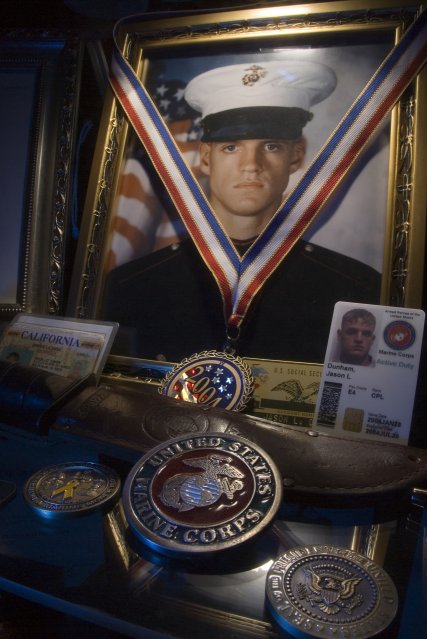
Corporal Jason Dunham, Medal Of Honour

On April 14, 2004, in Iraq near the Syrian border, Corporal Jason Dunham from 3rd Battalion, 7th Marines, used his helmet and his body to smother an exploding Mills Bomb let loose by a raging insurgent whom he and two other Marines tried to subdue. The explosion dazed and wounded Lance Cpl. William Hampton and Pfc. Kelly Miller. The insurgent stood up after the blast and was immediately killed by Marine small-arms fire.

Dunham lay face down with a shard the size of a dress-shirt button lodged in his head. The hard, molded mesh that was his Kevlar helmet was now scattered yards around into clods and shredded fabric. Dunham never regained consciousness and died eight days later at the National Naval Medical Center in Bethesda, Maryland, with his mother and father at his bedside.

Dunham’s commanding officers, investigated his actions and nominated him for the Medal of Honor. After two years and seven months making its way to the White House, the nomination had the necessary approval from the president who presented posthumous award of the United States highest military decoration, to Marine Cpl. Jason Dunham of Scio, N.Y. His parents accepted it in a ceremony in the ornate East Room of the White House.

“The public now knows what Jason did,” said his folks. “We still have a loss, but the gift that Jason gave helps us go on.

President Bush said “We remember that the Marine who so freely gave his life was your beloved son. We ask a loving God to comfort you for a loss that can never be replaced, As long as we have Marines like Cpl. Dunham, America will never fear for her liberty.”

Before Dunham, the last Marine actions to earn the medal happened May 8, 1970, in Vietnam, according to Marine Corps History Division records. A Medal of Honor citation details Lance Cpl. Miguel Keith’s machine-gun charge that inspired a platoon facing nearly overwhelming odds: Wounded, Keith ran into “fire-swept terrain.” Wounded again by a grenade, he still attacked, taking out enemies in the forward rush. Keith fought until mortally wounded; his platoon came out on top despite being heavily outnumbered.

The last Marine to receive the Medal of Honor was Maj. Gen. James L. Day, who distinguished himself as a corporal in the Battle of Okinawa in 1945. On Jan. 20, 1998, more than half a century later, President Bill Clinton presented the medal to Day, who passed away that year.

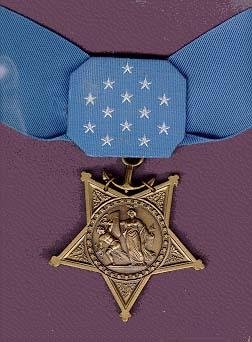
(Left: The US Navy & Marine Corps version of the Medal Of Honor)

Since the Long War began, the president has presented one Medal of Honor. On April 4, 2003, during Operation Iraqi Freedom, Army Sgt. 1st Class Paul R. Smith posthumously earned the medal for organizing a defense that held off a company-sized attack on more than 100 vulnerable coalition soldiers. In the defense, Smith manned a .50 caliber machine gun in an exposed position until he was mortally wounded.

These recent awards have fueled arguments from veterans affairs groups to the effect that with the changing face of war today in comparison to WWII, Korea or Vietnam; the award criteria for medals for valour should be ammended to reflect this change. With more than 3000 dead and thousands more wounded life is still as sacred as it was in previous conflicts and there are now different acts of heroism being performed today that are not recognised. This has apparently sparked discussion by the top-brass in Washington who will be reviewing criteria before 2009.