Tuesday, May 28, 2024

First Play Review - STAR WARS Jedi: Survivor [2023]


After EA games failed to truly capitalise on their custodianship of the STAR WARS licence, they were almost too greedy to realise that single-player games (with no microtransactions) were demanded by a starved player base and would be successful in the right hands. The success of STAR WARS Jedi: Fallen Order in 2019 proved to Respawn's overlords that EA had managed to make at least one good decision before their exclusive licence would expire in 2023. The announcement of a sequel - STAR WARS Jedi: Survivor, heralded a welcome continuation to a fantastic original game. However upon its release in April 2023, the reports of bugs and poor levels of optimisation especially on PC prevented me from daring to try it; certainly not for the cost of a new AAA game that now seems to have been abandoned by developer and publisher before fixing it for everyone. One year after release with eight patches and some tech savvy precautions combined with the game's release on the standard €5.99 a month EA Play subscription created the perfect opportunity to see if the negative reports held true for me.

I'm delighted to report that I had no issue running the entire game on ultra visual settings settings with no upscaling at about 75-85FPS on average. I did install the game onto the OS drive as opposed to my normal video-game drive as per Steam user recommendations and I kept the Ray Tracing setting off as every user that has tried to run the game with RT (even with an RTX4090 GPU) has failed. There was some stuttering and hitching but no more so than any other game in recent memory and any FPS drops  were infrequent enough to not consider them a bother and certainly nothing like the woeful performance I've observed on the initial YouTube videos for the title. A single crash at about hour 36 of a 40 hour play-through was the only significant hiccup to a game I did not think I'd be certifying as 99% flawless.


I'd encourage any potential Jedi: Survivor player to play the original to both get used to the game play format of platforming, puzzles and combat before taking things to the next level, and as the plot is also a direct continuation, players who have played the original will have a more emotional connection to the characters. With that said of course there is a "recap" cutscene that will play as you begin the game to set the main story beats and there are plenty of tutorials to relearn some old abilities as well as when you learn new ones, but this is clearly the middle part of a three-game trilogy (with the final game already greenlit) so it's best to experience it as it's intended - after Fallen Order.

While the opening narrative also serves as your 'tutorial' gently spoonfeeding you new powers and abilities as you progress, the Cal Kestis you're playing is a seasoned Jedi Knight and practitioner of an array of force powers that you enhance as you level up. You have your lightsaber and some tweaked force abilities from the original game and as one would expect from a sequel, a whole lot more to discover. These include but not limited to new lightsaber stances, force powers (with mind-trick now), gadgets and some interesting abilities for BD-1. The saber stances are particularity cool given that your lightsaber is pretty much the only weapon you use and can now use single, dual blades, saberstaff, crossguard (like Kylo Ren's saber) and one where you use a saber in one hand and a blaster in the other - so uncivilised! As with how to use and level your powers, the choice is ultimately yours.

The Jedi games are often  given the label "Soulslike", a moniker I disagree with as the Jedi games are not RPGs, have no inventory and little resource management and chiefly, unlike From Software's games you can turn down the difficulty from way-too-hard for me to 'story mode' allowing you to experience the game more cinematically. This means you to cut down enemies easier and more fluidly while preserving boss fights to last long enough as an on screen battle with a named/foreshadowed character  and presents a far more enjoyable experience to multiple tries as killing the same boss. I could have done normal difficulty as I did with the original, but I was aware that this game was about 25% longer and I was on an EA Play subscription time-limit. Survivor also evokes the Metroidvania moniker as once again  you need to return to previously explored areas with new abilities in order to progress. Honestly it's more like God of War than anything else I've played.

Death is inevitable however, even on easy mode because as with Fallen Order much of the traversal over the beautiful and diverse level environments is jumping, somersaulting, swinging and wall running high above or over an abyss of death beneath you. One wrong move and you fall, die and respawn instantly back at your last solid ground. The sheer verticality of the the level design evokes many an old LucasArts STAR WARS game and it's welcome here as well as creating a sense of awe and vastness. The acrobatics are not just for traversal though, they're also for a vast array of puzzles some which will need some elevated strategic thinking as well as using combinations of force powers, timing and gadgetry to overcome. The more difficult puzzles are hidden and rewards are useful but optional. The true reward is the satisfaction of accomplishment as you complete them.

There are three main groups in the game at you will come into conflict with, obviously The Galactic Empire is still hell-bent on eradicating the Jedi at the Emperor's command so they'll all be trying to kill you with more or less the same toys they tried to in Fallen Order. Natural wildlife can be friendly like the cute Bogling (which you can pet) or unfriendly like the unfriendly-sounding Bilemaw which will try to roll on you to flatten you (if it hadn't already killed you). The third group is the most interesting, the Bedlam Raiders are a criminal group that have spent some time repairing an entire army of all the various models of Battle Droids found in the husk of a crashed Trade Federation starship which had crashed during The Clone Wars. The raiders themselves are not much of a threat but the Battle Droids loyal to them are numerous and deadly unless you're paying attention.

The story picks up about 5 years after Fallen Order, so is set in 9BBY in STAR WARS reckoning, the same year as the Obi-Wan Disney+ show and about a year before the majority of events in Solo: A Star Wars Story. By now Cal's original crew/friends have left and he's taken up with a new crew sticking it to the Empire. A series of unfortunate events leave him and BD-1 stranded on the remote planet Kaboh where they uncover a secret of the Jedi Order from the time of the High Republic initiating a quest that will take them, with some old friends and new, on an even grander adventure than before.

Final Verdict: STAR WARS Jedi: Survivor is an incredible iteration on Jedi: Fallen Order and a worthy sequel with better visuals, puzzles, character customisation, open-world exploration and secrets with an expanded array of force powers, gadgets and fighting styles all to enjoy as you pursue a twisting, turning, shocking narrative that rewards your time. Hopefully the third and final part has a smoother launch than this.

Technicals: 40 hours playtime though Windows 11 with RTX4070Ti @ 3440x1440. 75-85FPS

Bugs: Some stuttering, not significant. One crash at hour 36. One stuck animation when a bounty-hunter 'tazers' your character (changing lightsaber stance releases the animation - thanks Reddit).

Availability: STAR WARS Jedi: Survivor is available from Steam or the EA Store €69.99. Due to the chronic performance issues documented by multiple sources, the inabily to use advertised features like Ray Tracing and the current "mixed" rating on Steam. I would strongly advise against rewarding the abandoning of needed continuous optimisation or patching efforts by EA/Respawn since January 2024 with a full price purchase for this or future games. The game is available through EA Play or XBox Game Pass, which is a far superior and safer value proposition. Reviewed copy played through a 30-Day EA Play subscription in April 2024 for €5.99.

STAR WARS Jedi games

Sunday, May 19, 2024

SPEARHEAD Command Reshuffle Complete

In the aftermath of the tragic death of SPEARHEAD Supreme Commander General "Knuckles" McKenzie, British Army in December and with the recall of high ranking Russian Federation officers to Moscow in the wake of the Ukranian conflict, the UNSC (United Nations Security Council) ordered a high level personnel reshuffle to ensure command continuity for SPEARHEAD. The changes were confirmed by the UNSC today.

SPEARHEAD Acting Supreme Commander Vice-Admiral "Smokestack" Henderson, USN (United States Navy) [left] has been promoted to the grade of admiral and confirmed as Supreme Commander. He previously served as SPEARHEAD Deputy Supreme Commander in 2018 after a year as SPEARHEAD Staff Director. In 2011, then Rear Admiral (lower) Henderson was UNETIDA Director in an acting capacity until his promotion to rear admiral to become SPEARHEAD Deputy Commander for Operations in 2012 and Deputy Chief of Staff in 2013. In 2009, Captain Henderson was the UNETIDA Naval Tactical Support officer for the Pacific region 2009.

Acting SPEARHEAD Deputy Supreme Commander, Army Corps General "Faucon" Davout was confirmed to the Deputy Supreme Commander billet permanently. He will be promoted to Army General later in the month by the French Army as the UNSC has raised the SPEARHEAD Deputy Supreme Commander billet to 4-star grade. Davout had been dual-hatting as Acting SPEARHEAD Deputy Supreme Commander and as SPEARHEAD Staff Director since December 2023. He was appointed to Staff Director in 2017 after serving as SPEARHEAD Deputy Commander for Global Strategic Plans while a division general. In 2013 then Brigade General Davout was SPEARHEAD Regional Operations Commander [Europe].

Air Marshal "Buzzard" Farington, RAF (Royal Air Force) is the new SPEARHEAD Staff Director replacing Army Corps General "Faucon" Davout who has been elevated to SPEARHEAD Deputy Supreme Commander.  Farington returns after previously serving UNETIDA earlier in his career as a wing commander in the UARF (UNETIDA Arial Reaction Force). More recently since 2021 then Air Vice-Marshal Farington was responsible for plans and policy during the establishment of the UKSC (United Kingdom Space Command).

Major General "Whopper" Creedon, USMC (United States Marine Corps) [right] has been promoted to lieutenant general and appointed as SPEARHEAD Vice Commander for Global Operations and Force Integration. He replaces Vice Admiral "Sextant" White who will retire from the Royal Navy. Creedon was most recently SPEARHEAD Deputy Commander for Global Security since 2018. As a brigadier general, Creedon was SPEARHEAD Assistant Commander for Intelligence and Information in 2013. In 2003 then Colonel Creedon, he served as UNETIDA Special Operations Commander and later as UNETIDA/UNPASID Director of Intelligence.

Zhong Jiang (lieutenant general) "Besra" Hu of the People's Liberation Army Air Force of China was appointed as SPEARHEAD Vice Commander for Strategic Weaponry in 2022 after succeeding Zhong Jiang "Huǒjiàn" Li of the People's Liberation Army of China who returned to his nation's command. As a Shao jiang (major general), Hu was appointed as the first SPEARHEAD Deputy Commander for Operations and Integration [Eastern] in 2017. In 2011 Da xiao (senior colonel) Hu was UNETIDA Air Operations Commander.

The billet of SPEARHEAD Deputy Commander for Satellite and Cyber Systems has been elevated to 3-star grade and redesignated SPEARHEAD Vice Commander for Space, Satellite and Cyber Systems. Air Vice Marshal "Nakshatra" Singh has been appointed to air marshal in the Indian Air Force to serve in the new position. He was previously appointed as the SPEARHEAD Deputy Commander for Satellite and Cyber Systems in 2022 replacing Major General "Circuits" Anderson, USAF (United States Air Force).

Major General "Shellshock" Hollister of the South African Army remains as SPEARHEAD Deputy Commander for Operations and Integration [Western]. He has held the position since 2018 and previously served as SPEARHEAD Assistant Commander for Recruitment and Selection.

Phon tri (major general) "S̄eụ̄x" Tham-boon of the Royal Thai Army is now SPEARHEAD Deputy Commander for Operations and Integration [Eastern] replacing Sojang (major general) "Sang-eo" Chang, ROKN (Republic of Korea Navy) who has been reassigned as the Republic of Korea military attache to NATO.

Brigadier "Magnum" Pike has been appointed a major general in the Royal Marines and will succeed Major General "Whopper" Creedon as SPEARHEAD Deputy Commander for Global Security. Pike was previously SPEARHEAD Assistant Commander for Security and Surveillance.

Canadian Army Major General "Tucker" Reid [left] remains as SPEARHEAD Deputy Commander for Manpower and Personnel since 2018. He previously served as SPEARHEAD Assistant Commander for Training and Instruction. 

Vice Admiral "Tridente" Carlos of the Spanish Navy, SPEARHEAD Deputy Commander for Global Strategic Plans remains in his position since 2018. He previously served as SPEARHEAD Assistant Commander for Naval Operations [Western] as a counter admiral.

The new SPEARHEAD Deputy Commander for Financial Management is Generalmajor "Freya" Hansen of the Norwegian Army. She replaces Wing General "Altísimo" Hernandez who has returned to a senior position the Mexican Air Force.

Tuğamiral (rear admiral) "Balina" Demirci, SPEARHEAD Assistant Commander for Naval Operations [Eastern] is to be promoted to the rank of koramiral in the Turkish Naval Forces and assigned as the SPEARHEAD Deputy Commander for Civil Affairs. He will replace Aluf (major general) "Jackal" Dahan who will return to Israel Defense Forces.

Generale di divisione (major general) "Calzone" Manganiello of the Italian Army remains Judge Advocate General of SPEARHEAD since 2022 when he replaced Air Vice Marshal "Magpie" Brown who retired from the Royal Australian Air Force.

The SPEARHEAD Director for Science, Technology and Research, Dr. "Quantum" Pataal of India [right] will remain in the position held since 2013.

The SPEARHEAD Inspector General Major General "Bugs" Casey, US Army replaced Generalmajor "Schakal" Nilsson, of the Swedish Army who retired in 2023.

Liwa (brigadier general) "Sphinx" Al-Khatib of the Egyptian Army replaced Major General "Sangja" Park of the Republic of Korea Army as SPEARHEAD Deputy Commander for Global Logistics and Installations in 2023.

The SPEARHEAD Surgeon General Major General "Scalpal" Johnson M.D, USAF will remain in the position held since 2018 when he replaced Major-general "Scrubs" Janssens M.D. of the Medical Component of the Belgian Armed Forces.

Mr. B will assume the duties of the Chief of Shadow Directorate when Mr. G leaves service in October. 

1-star appointments were not available at press time.

Friday, May 10, 2024

20th Anniversary Review - Star Wars: Battlefront [2004]

By the mid 2000's LucasArts had significantly reduced in-house development of their own games, instead licencing to other developers and publishing all games using the Star Wars brand. This practice gave rise to some incredible Star Wars games encompassing almost every gaming genre. These included  Bioware's RPG Knights of the Old Republic, Raven's 1st/3rd person shooter Jedi Knight II: Jedi Outcast, SOE's MMORPG Galaxies and Petroglyph's RTS Empire at War

The biggest success story however was Pandemic Studios multiplayer objective-based 1st/3rd person shooter Star Wars: Battlefront. This was a Star Wars take on EA's WWII Battlefield franchise and it hit the market at the perfect time. Battlefield was immensely popular at the time and a marketing tie-in with the original Star Wars trilogy DVD release as well as it being right in the middle of the Episode III hype train aided Battlefront in becoming the best-selling Star Wars game of all time at that point.

Being primarily a multiplayer game I never had much interaction with the Star Wars: Battlefront series. That said I have actually picked up most of them over the years so that one day I might sample their campaign modes just as a curiosity. With the "problematic" release of Aspyr's Battlefront Classic Collection earlier in the year and the fact that it's now 20 years since it launched I felt it was time to sample and on May 4th I tried it out!

From what I know about the original Battlefront, its single player campaign was apparently its weakest link. Basically a set of connected missions from either the Clone Wars (prequel) or Galactic Civil War (original trilogy) era. The player first plays as the Confederacy and later the Republic Army during the Clone Wars and then as the Galactic Empire and later the Rebel Alliance during the Galactic Civil War. My goal was not to spend too much time (or to even finish the campaigns) so I only sampled the initial levels of each campaign. 

For the prequels I played as the Confederacy as various models of Trade Federation Battle-Droids during their battle on the fields of Naboo against the Gungans. The objective was to eliminate the Gungan menace by destroying their Famba (large creatures which carried shield generators) and remove their advantage. I do admit to enjoying killing Gungans with heavy weapons but it was otherwise a simple victory. The next mission was much more difficult, securing the Naboo capital, Theed. Here I used several different types of Battle-Droids, including snipers and heavy weapons variations to eliminate Royal Guards and destroy weapon emplacements. I was defeated during the first of these but succeeded the second time. The third mission with  seemed much longer than the others and also ended in defeat so I turned my attention to the original trilogy campaign.

I was a bit more clued in to how the game was played now when I switched to this campaign. It was much more fun taking control of various Stormtrooper types as they pacified Sand People and Rebels on the deserts of Tatooine. My favourite death was being eaten by a Sarlacc that I got too close to. Once I was victorious in the Dune Sea, the next battle was in Mos Eisley. Here I fought as a Dark Trooper alongside Darth Vader himself and eliminated Rebel resistance in the spaceport, ensuring victory. I tried to save at this point and perhaps continue the next day but I could not actually find a way of doing this! Once I exited the campaign it wanted me to begin the whole thing again, something it was not my intention to do so I left it there.

I must note that I played the Steam version of the game which was released in 2019. It ran flawlessly at 3440x1440 @ 175FPS for the brief time I played. It had load-times for each level that while only mere seconds, still surprised me. The cutscenes for the campaign consisted of woefully digitised clips from the movies to "explain" the battles you were partaking in. It is the most bare-bones effort of storytelling in a game I've seen in a while but I wasn't expecting anything unique or specially crafted here.

Final Verdict: I think today, due to the superiority of it's sequels that this exists purely to satisfy the curiosity of students of game design, fans of gaming in general or to die-hard Star Wars fans. In my brief time with Star Wars: Battlefront and despite not playing against human enemies I can see the appeal of playing this shooter in 64-man battles where tactics were used, objectives completed and victory assured by the side with the best plan and communication. I look forward to similarly sampling the much lauded superior sequel Battlefront II soon enough.

Technicals: 1 hour playtime through Steam on Windows 11 with an RTX4070Ti @ 3440x1440/175

Bugs: None 

Availability: From Steam or GOG for €9.75. Review copy purchased for €5.48 in Nov 2019.

Star Wars: Battlefront series:

  • Star Wars: Battlefront [2004]
  • Star Wars: Battlefront II [2005]
  • Star Wars Battlefront [2015]
  • Star Wars Battlefront II [2017]
  • Star Wars: Battlefront Classic Collection [2024]

Wednesday, April 24, 2024

First Play Review - Beyond: Two Souls [2020]

Continuing my exploration of Quantic Dream's former PlayStation exclusive interactive drama games, I find myself at 2013's Beyond: Two Souls which finally got a Steam release in 2020 Following up Fahrenheit and Heavy Rain was a tall enough order for writer producer David Cage whose games stand out for their cinematic presentation, emotional storytelling, and unique gameplay mechanics.

Beyond: Two Souls follows the life of Jodie Holmes, wonderfully portrayed by the talented Elliot Page (credited as Ellen Page), a young woman linked to an incorporeal entity named Aiden. Over 15 years of Jodie's life, we witness her struggles, triumphs, and the mysterious connection she shares with Aiden. It can be played in a chronological fashion but the original narrative is non-linear, jumping back and forth through different periods of Jodie's life, which adds more depth layers to the story and keeps one engaged. Willem Defoe also stars as Nathan Dawkins, a researcher in the Department of Paranormal Activity who studies Jodie and her connection to Aiden and is also her surrogate-father-figure.

While it will come across as a bit contrived and one might notice some plot threads not satisfactory concluded, it's the storytelling that is the hallmark of Quantic Dream's catalogue. Beyond: Two Souls is no different and not unlike the investigations of Cage's previous characters, the narrative here tackles themes of identity, love, loss, life and death, and the supernatural with both maturity and depth. You guide Jodie through pivotal moments in her life, and you are confronted with moral dilemmas that have far-reaching consequences, shaping the eventual outcome(s) of the story. The branching narrative does encourage multiple playthroughs to explore alternate paths and endings but I committed myself to explore one path and live with the consequences even if it meant only experiencing 80% of the game. I believe save-scumming would be much more disruptive to the narrative flow in this genre than in an RPG. The story suffers slightly from a pacing issue with some sequences being overly long while others too short and feel rushed, but this isn't enough to detract from the overall experience too much.

In a game that is telling a cinematic quality story, the visuals are just as important and graphically the game is stunning for a 2013 PS3 game representing a high point for the console. It did receive an update for the PS4 in 2015 and the PC version supports 4K 60FPS with HBAO making it the definitive experience, and what an experience it is. The motion capture performances, lifelike character models and detailed environments blur the line between cinema and gaming, lending a greater sense of immersion. 

Quantic Dream have always created unique control systems for their games and Beyond: Two Souls is no different. It might be more intuitive on the PS controller but there is a learning curve on the PC. You have the point, click and drag mechanics as in previous titles but it's a different system here that certainly isn't everyone's cup of tea. Quick Time Events remain at the forefront, and you have to press specific buttons or perform actions within a time limit to progress. It's more involved than clicking a choice or "next" in a visual novel but nowhere near the complexity of an action game. The gameplay here serves the purpose of driving the story forward while immersing you in the cinematic experience in a unique interactive way and not as significant an aspect as in most other games. New to this game is being able to switch the player character, here between Jodie and Aiden, where the entity can manipulate the environment with supernatural abilities to aid Jodie in her activity.

The performances by Page and Dafoe, both award winning actors are flawlessly captured, incredibly nuanced, and elevate the emotional depth of the narrative significantly. The script for the game was around 2,000 pages long (compared with an average screenplay between 95 and 125 pages where each page is approximately one minute of screen time). "We'd do 30, 40 pages a day. It's insane compared to a film," Page said in an interview. "Jodie goes through a lot". Scottish composer Lorne Balfe composed a haunting and evocative score for score producer Hans Zimmer following the death of Fahrenheit score supervisor and Heavy Rain composer Normand Corbeil for whom this game is dedicated to.

Final Verdict: Beyond: Two Souls was the second game ever to be premiered at the Tribecca Film Festival so deep rooted is Cage's commitment to blurring the lines and pushing the boundaries between gaming and cinema and to even appeal to non-gamers. With its stellar performances, stunning visuals, and emotionally resonant narrative, it stands as a testament to the potential of interactive storytelling. While it certainly won't appeal to more hard-core gamers who desire total control over their in-game actions I maintain it's a unique and memorable journey that deserves to be experienced.

Technicals: 11.1 hours playtime though Windows 11 with RTX4070Ti @ 3440x1440/60.

Bugs: There was one sequence where I failed to manipulate the character's actions on screen. After a dozen attempts I gave up and continued on without issue without performing the action. I don't get the impression it was a significant branching choice in retrospect.

Beyond: Two Souls is available from Steam or GOG for €19.99 with significant sales occasionally. Reviewed copy purchased from Green Man Gaming in Dec 2020 for 7.96.

Quantic Dream releases (PS3/Console)[PC]


Parts of this review were generated by Chat GPT for time.

Sunday, April 07, 2024

First Play Review: Call of Duty: Modern Warfare Remastered [2016]

Note this review is for the 2016 release of Call of Duty: Modern Warfare Remastered, a remastered version of the original Call of Duty 4: Modern Warfare from 2007 and not to be confused with the 'reboot' Call of Duty: Modern Warfare from 2019. 


In 2007 Infinity Ward left the WWII era behind after phenomenal success with Call of Duty and Call of Duty 2 and brought the franchise to the modern day for their third game Call of Duty 4: Modern Warfare. It was quite a gamble to break from the comfort zone of Nazi-occupied Europe and leap into present day warfare, but it paid off. CoD4:MW was even more of a success, garnering countless awards from arts organisations and gaming publications. By 2013 it had sold more than 15 million copies.

In 2016 a remastered version of CoD4:MW was released with special edition copies of that years Infinity Ward release Call of Duty: Infinite Warfare. The remaster was developed by long time Call of Duty franchise assistant developers Raven Software who have made some of my favourite games. So rather than purchase a digital version of CoD4:MW to replay at some point in the future I decided to obtain Raven's remaster instead. 

The remaster itself is perfect because other than obviously superior visuals, there was no discernable changes. I was once again able to to wield many of the incredible tools of war used today such as manning the weapons of an AC-130 Gunship, which flies above the battlefield and fires 105mm rounds that decimate the enemy; make big explosions with Javelin missiles, which drop straight down to hit the thinner top armour of tanks; and cycle through a small arsenal of both light and heavy personal weapons featuring a variety of scopes and augmentations.
 
 
Unlike the previous Call of Duty's, Modern Warfare presents one continuous story. You hop between perspectives of a British S.A.S. soldier and a U.S. Marine 1st Force Recon operator. These leaps continue the progression of the story. Although I recalled many elements of the story since I last played, I had forgotten how a very effective tool the different perspectives were in telling it. The story itself isn't quite Tom Clancy but it still one of the most dramatically cinematic and exciting video-game plots as you can get, revolving around stolen Russian nukes and Middle-Eastern terrorists. The game is enhanced by Harry Gregson-Williams and Steven Barton's score lending a Hollywood class accompaniment to the experience.

The best thing here is the combat and gameplay. It's as much a linear and corridor shooter as its predecessors but the speed at which you need to perform actions is increased significantly. There many more enemies than the WWII CoDs and they're smarter too thanks to some refined AI. The bastards usually know to stay in cover. And they also know that you, being a well-trained soldier, aren't going to fight in the open, so they fling dozens of grenades and fire RPGs at you. They are trying to flush you out. Most cars explode and will kill you if you are standing beside them so one has to MOVE! Stay still and you die; Movement is life.

Fortunately, your squad-mates also benefit from some audacious programming. In this CoD game you're not in command either; you do the following not the leading and you're treated like a grunt from the start by your teammates. Speaking of: watch out for Billy Murray (The Bill) playing a decedent of the WWII CoD's Captain Price and Craig Fairbrass (Cliffhanger) as Gaz. It might be my imagination but in the remaster they don't stand in your way as much as they used to, and while you're aiming and fighting faster than ever now, that's only a good thing as you're less likely to kill your own men.

Final Verdict: Call of Duty 4: Modern Warfare was one of the best first-person-shooters on the market. While it was easily Infinity Ward's greatest work at the time, it was actually not too revolutionary, nor did it have to be. Raven did the did the best thing they could have done here and changed relatively nothing other than give an already perfect game a new coat of paint to be enjoyed by a new generation just as veterans enjoyed the original. Replaying the story here, however short (it is at just 5 hours) brought back how well crafted the whole original experience was and the remaster makes it absolutely sublime.

Technicals: 5 hours playtime using a Nvidia 4070Ti @ 3440x1440 with max settings on Windows 11. Windows HDR enabled.

Bugs: Two crashes. Solved by turning off shader preloading.

Availability: The pricing of the Call of Duty franchise still suffers from a phenomenal level of greed from Activision, even following the Microsoft acquisition. The €40 pricetag that's placed on Call of Duty: Modern Warfare Remastered cannot be justified as multiplayer is filled with hackerbots. Review copy purchased from Steam while on sale for €25.99 in Nov 2017.

Call of Duty series (PC Only):

  • Call of Duty [2003]
    • Call of Duty: United Offensive [2004]
  • Call of Duty 2 [2005]
  • Call of Duty 4: Modern Warfare  [2007]
  • Call of Duty: World at War [2008]
  • Call of Duty: Modern Warfare 2 [2009]
  • Call of Duty: Black Ops [2010]
  • Call of Duty: Modern Warfare 3 [2011]
  • Call of Duty: Black Ops II [2012]
  • Call of Duty: Ghosts [2013]
  • Call of Duty: Advanced Warfare [2014]
  • Call of Duty: Black Ops III [2015]
  • Call of Duty: Infinite Warfare [2016]
  • Call of Duty: Modern Warfare Remastered [2016]
  • Call of Duty: WWII [2017]
  • Call of Duty: Black Ops 4 [2018]
  • Call of Duty: Modern Warfare [2019]
  • Call of Duty: Black Ops Cold War [2020]
  • Call of Duty: Modern Warfare 2 Campaign Remastered [2020]
  • Call of Duty: Vanguard [2021]
  • Call of Duty: Modern Warfare II [2022]
  • Call of Duty: Modern Warfare III [2023]

Saturday, March 23, 2024

Replay Review: Far Cry 2 [2008]

Following on from my 2018 replay of the classic Far Cry, and as this very day is the 20th Anniversary of the franchise I felt it was time to investigate the next title in the franchise and experience the dangerous African plains of Far Cry 2. The original game was German developer Crytek's first game and one of the first FPS to evoke a sense of freedom by breaking out of the linear "corridor" gameplay of its genre predecessors. It used their in-house CryEngine and was published by Ubisoft. After Crytek signed a deal with Electronic Arts to produce a new CryEngine title (the infamous Crysis) Ubisoft struck a deal with Crytek to purchase the Far Cry IP, allowing their Ubisoft Montreal studio to create further Far Cry games using CryEngine technology. Far Cry 2 was the first of these.

Ubisoft's goal was to expand what had been done with the original game in both scope and scale, but not not to emulate the setting or tone established with the original which had various fantastical or sci-fi elements. Instead they decided to pursue a more grounded, realistic route and set the game in the very real-world premise of a diplomatically nameless African country where the only enemies were human beings from both sides of a brutal civil war. Ubisoft even eschewed their Tom Clancy franchise technical gadgetry here to evoke what little hope of survival someone had in this environment and while that didn't enthuse some people, it did earn the respect of others. Nevertheless the game was a success with over 2.9 million units sold in 3 weeks.

Playing Far Cry 2 again brought back memories of experiencing it for the first time 15 years ago. Playing it on hardware generations ahead of what I had back then reminded me that it and Crysis, it's contemporary, had some pretty hefty recommended requirements for its day like 2GB RAM, a Core 2 processor and a 512MB GPU! With all the graphical options turned up to maximum it's still a pretty good looking game for its age. Of particular note is spreading of fire, the lush jungle foliage, dust trails from your vehicle, mirage shimmer from overheated weapons, effects that were in their early days were beautifully realised in the Dunia engine, a version of the CryEngine that was mostly rebuilt for the game.

My original Far Cry 2 review published here in October 2009 was mostly story about a one-hour session in the game that isn't even part of the 'main story'. The best part of Far Cry 2 was the randomness of unscripted events or encounters and was not as prevalent then as it is today. Revisiting the game and seeing these encounters again doesn't obviously evoke the same awe that it did, but I do remember this game was one of the places where the modern versions of today's open world mechanics were first realised and for that it deserves acknowledgement.


The very light plot involves you as a mercenary sent to kill a notorious arms dealer called "The Jackal" who seems to be arming both sides of the civil war. You do this by gaining the support and trust of the warring factions by doing some of their dirty work. You are assisted by some 'friendly' NPCs with motives of their own who give you objectives that are somewhat aligned with your main objectives. Alternatively at any point you can pursue missions that provide medicine for your crippling malaria affliction or perform raids for the arms dealers to improve your weapons and skills. If the original Far Cry took influence from The Island of Dr. Moreau, then this takes it's cues from Apocalypse Now and Joseph Conrad's Heart of Darkness. There are no heroes here, and don't count on a happy or even a good ending for anyone.

The serious and somewhat bleak tone is only the setting in which the tale is told. The gameplay and action itself was remarkable for it's time and is still in essence of what Far Cry is today. The African landscape is as beautifully realised as it could have been in 2008. The open world areas cover a frankly huge 50sq KM necessitating vehicular transport for the most part - and there are a plethora of vehicles from ATVs to armed assault wagons and gunboats to operate. As mentioned, there's not a lot of gadgets but you do get a GPS device and a map to aid in navigation to identify where your objectives are.

In true Ubisoft fashion the entire world is against you, and tries to shoot or kill you on sight. Despite being in Africa, there are no wild animals in this region so you're safe in that regard (the era of the deadly honey-badger was not yet upon us) but everyone is armed and angry and you're perceived as a threat, so expect bullets to be flying at you as soon as the opening cutscenes end. You have a huge array of weapons and equipment to chose from and can carry three weapons in addition to your trusty machete with some grenades and Molotov cocktails. Missions involve storming or infiltrating encampments. You can adopt a frontal assault, or try a stealthy approach, there are even different  options within these approaches to complete a mission in a true deviation from a linear shooter.

Final Verdict: Ubisoft Montreal achieved its goals with its first Far Cry game and it was the true foundation for a franchise that still exists today with lush and interesting open worlds, unscripted encounters, charismatic antagonists and an array of weapons and tools to complete your objectives in more than one linear way. While Far Cry 2 itself may not be popular enough to require a remake, I hope it remains available and working for all users for years to come, with or without some light remastering.

Technicals: Approx 30 hours via Ubisoft Connect on Windows 11 at maximum graphical settings with a 4070Ti at 3440x1440 @ 60FPS

Bugs: Animations are broken on high refresh rate (175Hrz), FPS had to be capped to 60 to fix. One instance of an NPC stuck inside a rock.

Availability: Far Cry 2 is available from Steam, GOG and the Ubisoft Store for €9.99, but is frequently sold for €3 or under. Review copy purchased for €3.33 in Nov 2017

Far Cry series (PC releases only)

  • Far Cry (2004)
  • Far Cry 2 (2008)
  • Far Cry 3 (2012)
    • Far Cry 3: Blood Dragon (2013)
  • Far Cry 4 (2014)
    • Far Cry: Primal (2016)
  • Far Cry 5 (2018)
    • Far Cry: New Dawn (2019)
  • Far Cry 6 (2021)

Saturday, March 09, 2024

First Play Review: Yakuza 0 [2015] [PC2018]


At the turn of the century and the failure of it's  Dreamcast console, SEGA pivoted to become a third party game developer. Game producer Toshihiro Nagoshi pitched a Yakuza game for SEGA to develop for the Sony PlayStation 2. His idea was simple: an action-adventure RPG-lite brawler with mini-games in that the player would live the everyday life of a member of the Yakuza and be an open world in the same vein as Shenmue (a Dreamcast game Nagoshi had worked on) but obviously exploring more adult themes. SEGA immediately rejected the idea as it had traditionally made games for younger audiences and violence between humans was something rarely explored in Japanese video games. Despite this resistance (and from Sony for similar reasons) Nagoshi was relentless in his pursuit to the point where he offered to resign if his game failed. Yakuza was eventually green-lit and needless to say achieved remarkable success - in Japan.

Until the Western release of the prequel Yakuza 0 in 2017, despite the popularity of the multimedia franchise that spawned around it, the Western market needed some additional convincing. The Yakuza series had been a very niche product in the West never translating into blockbuster territory. After SEGA purchased the localisation studio Atlus and put them to work on the Yakuza series, the tide turned. A 2018 shareholder report stated that Atlus understood both Japanese and American games and is "able to localize Japanese games in a way that accurately conveys the unique worldviews of Japanese titles to local gamers." Seven years on I suspect there are few Western gamers who have never heard of the Yakuza franchise. Last year Mark Twomey insisted I play Yakuza 0 as the franchise was being released in bargain bundles in advance of the latest instalment. I knew it was time...

You can often use environmental objects to fight with

Yakuza 0, although the sixth mainline entry in the franchise, is a prequel to the original Yakuza game and so marketed as an ideal starting point ahead of remakes/remasters of the original Yakuza games for the PS4/XboxOne/PC. It's set in the late 1980's when the series' main protagonist Kazuma Kiryu was just 20 years old and is framed for a murder of a loan shark's client in an abandoned property lot at the center of a land grab by powerful interested parties. The game also switches perspective to reveal the origin of Goro Majima, a series regular who, as an expelled Yakuza, is given the opportunity to return to the family once he performs an assassination which he is reluctant to do.

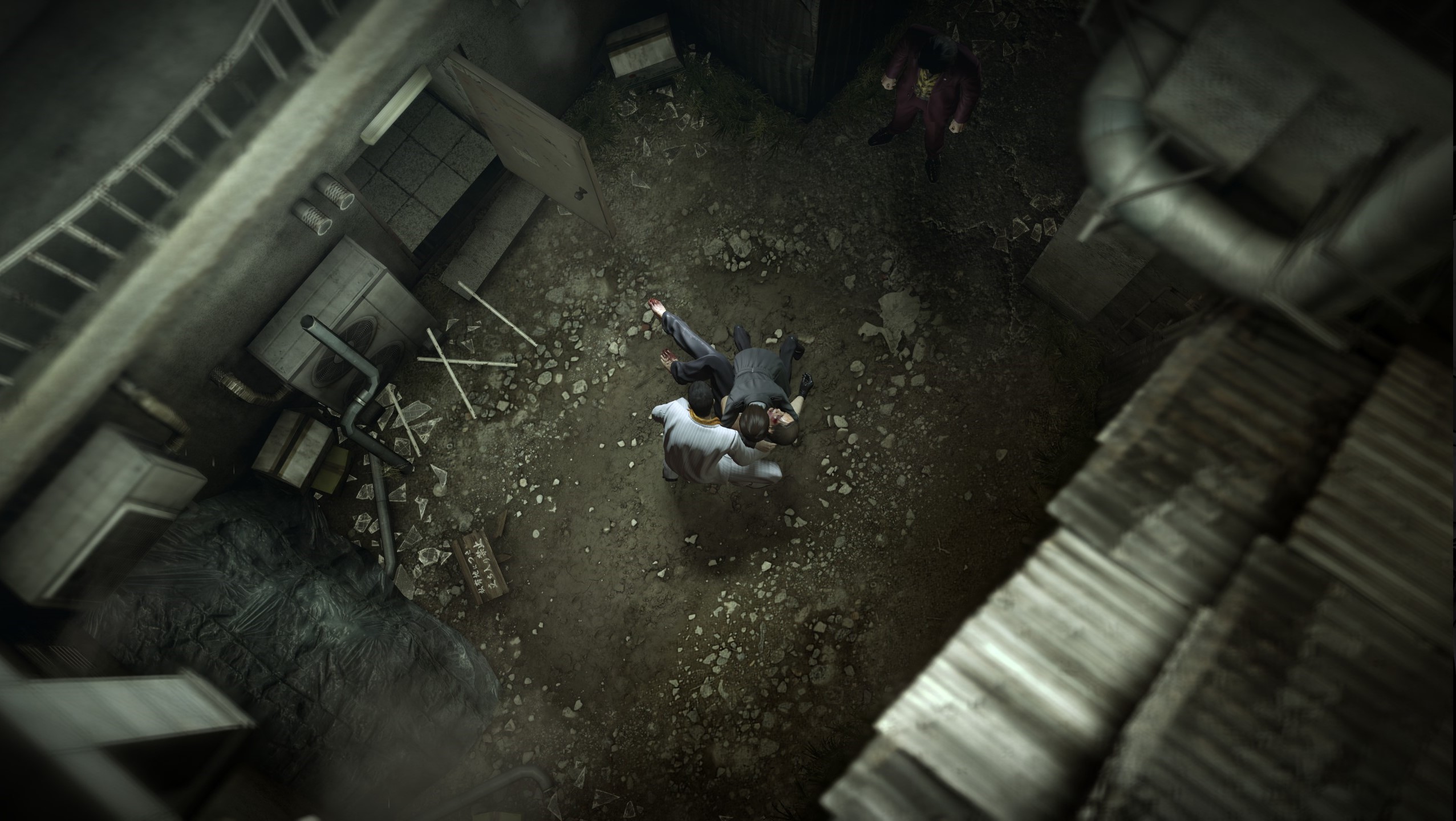
Gameplay involves you as either protagonist navigating two fictitious representations of real life Japanese city districts Kiryu in Kamurochō, Tokyo and Majima in Sotenbori, Osaka. As you progress you are forced to combat literally hundreds of enemies using martial arts of varying styles. As you eliminate enemies you gain their money which is not only currency with which to purchase goods and services but is also the games XP and used for levelling your fighting skills and abilities. As you explore you encounter, various NPCs which can be interacted with. They either advance the plot, sell goods, reveal new mini-games or of course want to kill you forcing you into mini combat situations. Many NPCs however are there for side-quest purposes and revel new stories outside the main narrative and flesh out the world and can be to completed or ignored as you desire.

Shit gets weird sometimes

This game wasn't really like anything I've played before. Combat is brawling but more complex than in  Batman: Arkham. Navigating bustling streets reminds me of early Assassins Creed games but without parkour. It's heavy on the epically long cutscenes like in MGSV: The Phantom Pain and Final Fantasy XIV but this tale is more grounded in reality. The sheer amount of extra content provided by the game's additional systems and mini-games that have little or no bearing on the central plot are staggering and I've never seen the like. As I write trying to compare it to anything I know, I feel it's a misrepresentation, Yakuza 0 really is its own thing in the action-adventure genre and that's a strength when so many games are similar to one another.

The game suggests you use a controller and I'd certainly understand that considering the console origins but I tried with KBM and while a bit finicky at the beginning it became fairly fluid. However while the fighting was OK it's not gameplay that I'm too enamoured with. One major issue is the saving method. The game has no autosave nor the ability to save at any time. To save, one has to direct your character to a pay-phone which allowed saving/loading and some inventory management. This was a terrible design as you couldn't save just before a combat encounter and if defeated you may be forced to play from a point too far earlier to be 'fun' after repetition. I became tired the combat in general before long, especially during boss fights where I'd die or my fingers would get too tired before the boss' health bars (yes multiple) would run out. So rather pausing for a rest which would break immersion, I countered the game's flaws using a memory hack that gave my characters invincibility and permanent heat (stamina). While this trivialised basic encounters, it also shortened the boss fights (which were still awesome) and made it irrelevant to waste time traversing to a save point as I could no longer be defeated. I enjoyed the gameplay much more when I did this. The actual brawling and fighting isn't the main draw for these games however, in fact it's not considered great by most players, instead the real draw of the Yakuza series is the plot and side-content/mini-games.

Mini-games include dancing

While the main path of Yakuza 0 is deadly serious to phenomenally dramatic proportions, the side content splattered throughout the world is genuinely bizarre, cringe and hilarious in equal measure. There are minor side-quests scattered throughout the world that you could easily miss but if you find them you will be rewarded with a fascinating insight into Japanese culture and all that comes with it. Some quests I found were to help a small boy get his video game back from a bully, assisting a new aspiring dominatrix be more dominant, and having a drink with a government advisor giving him ideas on how to increase taxes and what percentages should be charged. Side games like playing mahjong, remote-control car racing or singing karaoke can be played. Other side-games include ways of accumulating greater wealth such as managing a real estate empire by buying up land and putting rivals out of business or managing a cabaret club by hiring girls to provide an evening's companionship. The depths of most of this content were fascinating but ultimately would have taken too long for me to explore, perhaps I will do so in later entries.

Yakuza 0 is is a character driven game with a movie quality, branching, arching and twisting plot that despite starting out pretty weak, soon blossoms into one of the most well written, surprising and incredible stories I've ever witnessed in interactive media. From other Japanese games I've played I'm used to a concentration on a strong lengthy narrative more than is done in the West. This game is no different and easily has hours of cutscenes including an epilogue that finishes 40+ minutes after the 'final boss' and so you basically sit and watch without any interaction for that length of time. For some this level of non-interaction will be too much but for me the 5 or 10 minutes of well acted, fully motion captured narrative every once in a while allowed me a rest from the button mashing combat. Had this been a visual novel game I'd probably have enjoyed it just as much. The only gripe I have is that there must be over 100 characters, all with Japanese names that can't be easily remembered especially as so many begin with the same letter; e.g. Shimano, Sera, Sagawa and Shibusawa are four very different people!!

The drama is portrayed with cinematic-level techniques and quality

Final Verdict: Yakuza 0 is unlike anything I've ever played. I've never enjoyed a game where I've found the combat so weak but this is a unique situation where experiencing the game is a greater reward than actually playing it. The developers' love of Japan and its eccentricities are obvious and exploited for our entertainment. It is easily one of the best narrative experiences ever to be digitised and was a huge success for SEGA with the original PS4 release selling out in Japan. I'm now looking forward to what the rest of the series has to offer.

Technicals: 33.5 hours through Steam on Windows 11 with an RTX4070Ti @ 3440x1440 175Hz.

Bugs: One crash recorded.

Purchase Options: Available on Steam or GOG for €19.99 and often found in a discounted bundle with others in the series. Review copy purchased from Steam for €6 in July 2023.

Yakuza/Like A Dragon franchise (only PC releases shown)

  • Yakuza 0 [2018]
  • Yakuza Kiwami [2019] 
  • Yakuza Kiwami 2 [2019]
  • Yakuza: Like a Dragon [2020]
  • Yakuza 3 (Remastered) [2021]
  • Yakuza 4 (Remastered) [2021]
  • Yakuza 5 (Remastered) [2021]
  • Yakuza 6: The Song of Life [2021]
  • Judgment [2022]
  • Lost Judgment [2022]
  • Like a Dragon: Ishin! [2023]
  • Like a Dragon Gaiden: The Man Who Erased His Name [2023]
  • Like a Dragon: Infinite Wealth [2024]

Wednesday, February 21, 2024

First Play Review: Mirror's Edge [2008]

I saw Josh Strife Hayes play Mirror's Edge recently and thought I might get it and give it a go. Developed by DICE of Battlefield and Battlefront franchise fame in 2008 for Electronic Arts, Mirror's Edge is a first -person free running adventure game where movement and timing are key to success.

The game casts you as Faith Conners a young free runner who lives in an outwardly comfortable and crime-less society society but in secret is rebelling against the totalitarian regime that controls the media and citizens. Once her police-officer sister is framed for murder, Faith is relentlessly pursued by other members of the security forces "Blues" and must investigate the murder and clear her sister while evading Blues by jumping rooftop to rooftop. The story is written by Rhianna Pratchett and told mostly through a series of beautifully and stylistically animated cutscenes when you're not racing through the FPS world.

As the game was inspired by the parkour action scenes of Casino Royale and The Bourne series of movies, the most present aspect of the game while playing is movement. Fast, nimble and agile movements are required from your character as an extension of the player's hands. It's your job to manipulate Faith's abilities as she runs and jumps through an environment where one single fumble or misstep could be her last (until it reloads the checkpoint). The environment itself is unique for such a game. It's comprised of mostly white coloured walls and buildings with some features coloured in more significant colours, blue, orange, red, yellow or green in order for them to stand out and draw your attention. Red objects for example, are important as their placement means faith can use them to grab on to or jump from. Your eyes are drawn to the colours and identifying these objects and using them is crucial to the split-second decisions when you're moving and often evading weapons fire coming from behind you.

Combat is a very secondary mechanic here. Despite her slight frame an unarmed Faith can best a fully armed and armoured Blue with fists and feet, swift movements to evade being shot or clubbed, or grab a weapon from the floor or being held by an enemy. When you grab a weapon you can use it to shoot and kill enemies but it slows you down and you can't grab the surfaces you will likely need to use to evade other enemies so it's best not to hold onto it for long; this isn't a 'real' FPS.

While I enjoyed my time in the game I found that after almost 5 hours of excessive trial & error gameplay that the jumping mechanics required to progress were just a little beyond my skill or patience to learn. I also wasn't engaged enough in the story to investigate if there were cheats to "fly" as that more than a god-mode would be more necessary to progress. A pity to end in the middle, but something I can live with. 

Final Verdict: It's clear from the get go that DICE set out to make something fresh and unique and focus on traversal rather than combat or exploration to establish a new type of game. It was a great idea and implemented well. The sequel Mirror's Edge: Catalyst was not as well received and I doubt the franchise will continue. Mirror's Edge has a cult following and place in the hearts of those who love it, love parkour or enjoy trying new things.

Technicals: 4.5 hours approx on Windows 11 with an RTX4070Ti @ 2540x1440 / 60FPS

Bugs: Offers 21:9 resolution but displys in 16:9. One freeze and lock-up (reported as a common error in forums).

Availability:  Steam/GOG/EA Store €19.99. Review copy €1.89 from GOG in January 2023.

Mirror's Edge games:

  • Mirror's Edge [2008]
  • Mirror's Edge: Catalyst [2016]

Sunday, February 04, 2024

First Play Review - Starfield [2023]

While I have dabbled in The Elder Scrolls III: Morrowind and did spend an hour in the original Elder Scrolls: Arena I've largely somehow managed to not play a Bethesda Game Studios game to any significant degree. I'm acutely aware that both the Elder Scrolls and Fallout franchises are recommended, I have in fact every single, and I mean every single game in those franchises (including the non-BGS games) in my backlog library still unplayed. I'm well informed that for the most part they're considered great. especially Skyrim but I never just got around to installing or playing them yet.

In 2018, Bethesda announced Starfield, their first new IP in over 25 years and one set in the vastness of space. The subsequent 5 years of hype led to the belief that we were going to get a true next-generation Mass Effect-rivalling space RPG adventure with exciting FPS shooting, in-depth spacecraft and outpost building and enough open world exploration on 1000 planets to last 10 real years. I knew before too long that this was going to be my first ever properly played BGS game. When the game was finally released on September 6th 2023 however, the expectations from the hype began to be shattered. What we did get was a mediocre RPG with a lagging main plot, last gen graphics (with no DLSS, HDR settings or an FOV slider*) pushed by an ageing creation engine, and while 1000 planets were delivered, they all had the same identical structures which most players were bored of within 10 days let alone 10 years. Most egregiously - all of the game systems and areas were separated from one another by literally dozens of loading screens as if from the age of gaming gone by.

Initially, Starfield is an exciting new prospect, you create your character and embody a miner who uncovers a buried artefact of unknown origin and experience a mesmerising vision. You join up with a group of privately funded space explorers to find answers and unlock the mystery you have discovered. I was warned not to expect too much from the 'main plot' of a Bethesda game and being well versed in completing side quests before advancing any main plot I basically collected every faction quest, side quest, odd job, bounty and delivery mission I could and did a whole lot of that before continuing the plot. Once I came to terms with the idea that faction quests and some side missions were far more interesting than unlocking the secrets of the universe, I enjoyed myself a lot more.

Traversal varies from OK to abysmal. In city areas (with no map) for the most part, you're always on foot but can use a boost pack to increase speed or altitude depending on where you're going. It makes sense while exploring the unknown to use it especially as for some stupid reason Bethesda didn't give you any vehicles to use in their open world areas that cry out for some way of quickly traversing their mostly featureless landscapes. FPS combat is actually pretty good for an RPG; Id Software (whose publishers are Bethesda) were brought in to help with that for obvious reasons, and their expertise is clear from the quality of the combat and weapons. Space combat isn't too involved and gets trivial when you get the hang of upgrading your ship beyond all competition. 

While there are no 'survival mechanics' in the game (probably for the best), there is a punishing inventory system which is possibly the worst I've ever encountered  in almost 30 years of inventory management since Diablo. In a world where you have technology like artificial gravity, you have a pitiful carrying capacity compared with the amount of equipment you feel you should be carrying around with you. It's worse in the early game because you don't have weight-limit reducing equipment or perks and you actually want to pick up stuff to sell for credits. But if your ship is 3-5 minutes away on foot and your carrying loot, it becomes a 10 minute journey because when you're encumbered, you're slower and you develop breathing trouble if you try to run - and unlike every situation in the rest of the game where you can just fast-travel - when you're encumbered, you can't fast travel! This is the only time when you literally would always chose to use fast travel and BGS says no! It's infuriating and the only thing I eventually modded out of the game was the numerical "weight" of all items. If I couldn't do that, I'd have quit.


I sunk considerable time in the researching and modifying of weapons, ship construction and base building. I genuinely enjoyed playing with these systems especially creating your own star ship where I was able to eventually craft a near-invincible vessel which shredded enemy spacecraft in seconds. Personal weapons were also interesting to upgrade and I reached a point where I was carrying the best weapons to eliminate any mob, human pirate or alien beast and carry thousands of rounds of ammo for each. These situations posed their own issue, when the slightest hit from your least powerful weapon one-shots your enemy it does seem a bit cheesy, so I turned up the difficulty for the first time in a game in a very long time to compensate for being so overpowered due to crafting min-maxing.

Starfield has a very broad gameplay loop, it's probably fairer to say it has several gameplay loops. No game session need be exactly the same - you can proceed with the main plot, do one of the vastly superior faction quests, spend time researching and applying upgrades for your weapons and equipment, design and build a base which can mine resources and establish transport hubs around the galaxy. You can design and build your own spacecrafts, fly around space in said spacecraft as a space-trucker, be a pirate, explore new star systems, be a bounty hunter and destroy pirate vessels. You can travel to and land on planets and explore, kill wildlife, extract resources, raid outposts and collect bounties by eliminating nefarious individuals. There is a lot to do that's up to you how much you want to do of it. 


Starfield's 1000 planets is supposed to be a selling point BGS is proud of. In reality it's too big a player arena. Only some 10 or so planets have meaningful content established in cities or settlements but the other 990 are variants of what you'd expect from what passes for procedural generation among game developers. The overwhelming majority are dull anaemic experiences where you as a player with a mind-numbingly slow jetpack spends far too many long laborious minutes hitting space-bar from your ship to a point of interest. Imagine the jaded reaction you'd have when you reach the point of interest to find out that it's the same procedurally generated structure as the last one you found on a different planet, the only difference is the gravity here is lighter or the surrounding rocks are a different colour. Bethesda seem to think that because Neil Armstrong wasn't bored by exploring our barren moon we should be filled with the same sense of awe. They seem to misunderstand that Armstrong while certainly was in awe and doing something no one had done before, (which was his purpose), but was also doing his fucking job and was being paid to do it! As players were expect exciting entertainment from minute to minute and are paying for that - that's the purpose of entertainment.

Starfield's technology is frankly abysmal. For starters, the Creation 2 engine looks like it's state-of-the-art for 2013. In 2023 it pales in comparison to something like Unreal Engine 5 and it further compounds players bafflement when you're met with loading screens every time you want to go somewhere to enter small areas like one room shops in cities or even when leaving your own ship on a planet which you can clearly see has already rendered outside! The segmented nature of the game suggests the engine cannot handle areas even a fraction of the size that most other game have been doing for the past 10 years or more. There's no atmospheric travel or control over your landing site; something No Man's Sky handles without issue so something with the scale and scope of Starfield feels like a regression of technology by comparison. Loading screens aren't annoying in games from 2003 because people understand they were a necessary solution for the game developers to stitch content together and back then did not know any better. Game designers have since been leveraging technology in the meantime to no longer require loading screens to to modern engines, and when they are required, blank loading screens are masked them with clever cutscenes or using narrow passages between areas where you can only go forward until the content on the other side is loaded. Starfield just gives you blank screen with a timer depending on where you're going and it's jarring to the immersion and totally absurd in 2023.

Final Verdict: Starfield is not a broken game but it's a deeply flawed design at a fundamental technical design level. However, it was still somehow compelling to play and engage with all its systems to see what you can do.  There is a vast quantity of experiences but precious little depth in most of them to back them up and this won't suit everyone. It's honestly not bad enough to hate, or anyway good enough to love and I'm unsure what can be done to fix it as the is the core of the game, decisions made at the outset of its design were fundamentally flawed and I doubt DLC or mods can fix it.

Technicals: 350 hours via Steam on Windows 11 with an RTX4070Ti at 3440x1440 at 60FPS approx (120 FPS approx with DLSS after many weeks). HDR (available weeks after launch) enabled in game.

Bugs: Starfield is heralded as BGS' least buggy game. I encountered some floating rocks, unclothed NPCs, NPCs that would float into the air, missing spacesuit and helmet visuals while on a planet without an atmosphere but none of these actually prevented me from progressing with anything I intended to. One bug however prevented enemies from appearing on enemy ships, so if you boarded them in space they'd have no crew or if they landed, no crew would disembark. Entering a code in the command line corrected this bug however so it was an easy fix.

Purchase Options: Available on Steam for €69.99. Review copy purchased from Steam for €56.93 in Sep 2023.

 *These features were added in December 2023