Saturday, January 28, 2023

Replay Review: Call of Duty 2 [2005]

Following on from my Classic Review of 2003's Call of Duty in February 2020, and after a time in a fictitious representation of WW2 in Return to Castle Wolfenstein in recent weeks, I said I would return to the 'realism' of Activision's WW2 shooters in Call of Duty 2 and see if it hold up today. This was Infinity Ward's second World War 2 outing after the original CoD (or third game counting Medal of Honour: Allied Assault as most of 2015's developers went to IW after EA gave them the shaft) and it was clear their experience and expertise was what made the games special as Infinity Ward produced 9 in the currently 19-game franchise, while Medal of Honor died on the barbed wire fence 10 years ago.

Call of Duty 2 mimicked it's predecessor somewhat in so far as it featured not one central protagonist as most other games but gave you slices of the war through the eyes of several fictional soldiers who fought with real units in dramatized but historically researched encounters. For the Russian campaign, you are  Private Vasili Koslov of the 13th Guards Rifle Division, who after the defence of Moscow takes part in the final assault to recapture Stalingrad in 1943. As Sergeant John Davis of the 7th Armoured Division in North Africa you assault the trenches and machine gun nests in the Second Battle of El Alamein in 1942 later taking the role of British tank commander, David Welsh, engaging German forces in Libya. Finally you are Corporal Bill Taylor of the 2nd Ranger Battalion who climbs to assault Pointe du Hoc on D-Day, later takes Hill 400 and finally the Rhine River crossing in 1945.

As with Call of Duty there is no suggestion that you win WW2 all by yourself, you are constantly supported (or sometimes hindered by the AI of) your ever-present squadmates. If you are sent somewhere alone it's literally into a bunker or a building to shoot a bunch of Jerries, your team mates are less than 30 feet from you if not shooting and throwing grenades into buildings. There is an active "chatter system" where both friendly and enemy soldiers will call out the position of each other as they shoot. And shoot you will, you are once again restricted to being able to hold just two weapons such as a Lee Enfield and a Sten Gun, while you will eventually run out of "allied ammo" as you progress, one does best to pick up a German rifle and a machine gun for both far and closer-range enemies.

In every respect Call of Duty 2 is a step up from the original. It uses an enhanced IW Tech 2.0 engine a version of idTech 3 with a skeletal animation system, which was useful when depicting the Jerries getting blown into the air from grenades. The game was also an early example of true volumetric smoke effects especially useful for smoke grenades and the desert tank battles of it's British Campaign in North Africa. CoD2 also featured a regenerating health system preventing the action from being 'paused' as you went foraging for heathpacks. The game also introduced the franchise staple of the 'grenade indicator' letting you know that a grenade was near and to run or take cover. While the game did not have big-name voice talent this time, Hollywood composer Graeme Revell provided a remarkably less martial but more fitting score for the seriousness of the game than was achieved by Giacchino.

Final Verdict: Call of Duty 2 brought more dramatic realism to the WW2 FPS genre using carefully researched locations and astounding development technology to bring a teeth rattling, visceral experience though awesome sound and breathtaking visuals. While obviously aged Call of Duty 2 surpassed what came before and was as one would expect, surpassed by it's later successors. It was the best of it's time but is still great to look back on a fun shooter in 2022.

Technicals: 7 hours (approx) playtime using a Nvidia 3070Ti @ 3440x1440 with max settings on Windows 11. Windows HDR provided a negligible amount of superior lighting.

Bugs: None.

Call of Duty 2 suffers from the same prohibiting issue as it's predecessor in that it is available from Steam for €19.99 which for a 17 year old game is fucking ridiculous. This is the worst thing I've personally experienced with Activision - while the game certainly was worth the full price in 2005, today most 17+ year old games are under €5 when on sale but the pricing of Call of Duty franchise, even when the maximum 50% off remains premium and thus prohibitive to this day. 

Series (PC Only):

Call of Duty [2003]
- Call of Duty: United Offensive [2004]
Call of Duty 2 [2005]
Call of Duty 4: Modern Warfare  [2007]
Call of Duty: World at War [2008]
Call of Duty: Modern Warfare 2 [2009]
Call of Duty: Black Ops [2010]
Call of Duty: Modern Warfare 3 [2011]
Call of Duty: Black Ops II [2012]
Call of Duty: Ghosts [2013]
Call of Duty: Advanced Warfare [2014]
Call of Duty: Black Ops III [2015]
Call of Duty: Infinite Warfare [2016]

- Call of Duty: Modern Warfare Remastered [2016]
Call of Duty: WWII [2017]
Call of Duty: Black Ops 4 [2018]
Call of Duty: Modern Warfare [2019]
Call of Duty: Black Ops Cold War [2020]

- Call of Duty: Modern Warfare 2 Campaign Remastered [2020]
Call of Duty: Vanguard [2021]
Call of Duty: Modern Warfare II [2022]

Monday, January 23, 2023

"No credible threat from planet within the Earth" - SPEARHEAD

Danish seismologist Inge Lehmann discovered in 1936 that Earth’s liquid outer core covers a solid metal ball effectively floating in the center of the planet. Today, Scientists reported in the Nature Geoscience journal that this core spins and every few decades the rate and direction changes, and at present the planet is in the midst of one of these changes! Study author Professor Xiaodong Song, a seismologist at Peking University in Beijing explained that the core is thought of as “a planet within a planet.”

SPEARHEAD's Deputy Commander for Global Security Major General "Whopper" Creedon assured an emergency press conference via video link in the SPEARHEAD Public Relations Suite at UNHQ in New York an hour ago that there was "unlikely anything to worry about!"


 "While we admit that the thought of a metal ball rotating beneath our feet is disconcerting, we do not believe it poses a clear and present danger to the future of the planet," informed Creedon "Despite how it does sound like the premise if a low budget doomsday apocalyptic direct-to-video movie only found when you scroll too far down the menu of Amazon Prime."

Once the press had recovered from Creedon's comedic genius, he added that so far there was no credible reason to take Professor Song literally. "We have no current evidence to believe that there is in fact a separate planet within the Earth. Rest assured that should we confirm that there is, and if a credible threat was faced from the inner planet that we would take any and all measures to defend ourselves and if necessary take the ultimate action to destroy it!"

Creedon took just two questions before abruptly ending the conference. The first question pertained to the aforementioned "ultimate action" and if SPEARHEAD was aware that if they destroy the Earth's core, all life on the surface would cease regardless of the method used. Creedon responded "No comment". The second question pertained to the possibility of the change in rotation of the core affecting the ecology of the Molemen Empire beneath the Earth's surface. Creedon didn't answer, but directed SPEARHEAD personnel to escort the reporter to a windowless office off to the rear of the building.

Source: https://www.nytimes.com/2023/01/23/science/earth-core-reversing-spin.html

Saturday, January 21, 2023

The Epic Games Store and the past 4 years


Introduction

In late 2018 Epic Games launched The Epic Games Store (EGS). While publishers opening their own stores was certainly nothing new with Blizzard, EA, Ubisoft for example all having their own stores, Epic had it sights on competing with Steam in so far as offering developers and publishers to sell their non-Epic related games on their store just as Valve sell non-Valve games. While competition is healthy especially as games, especially the more popular AAA titles aren't cheap, the store was laughable at launch and didn't make much of an impact. It wasn't long however before the Epic Games Store became rather famous - and not for the right reasons. 

The platform was crap, and still is

When you compared it to Steam or GOG, both with years of development naturally any new platform is going to look and inferior by comparison but eventually it gets up to an acceptable standard with a good user experience and all the bells and whistles. That's at least the theory; the reality for the EGS was that development has been slow with features like a shopping cart only added within the last year. Community interaction is absent, so visibility on game performance, issues, workarounds etc. is non existent. 

Additionally reviews aren't implemented at all which means that you have to go off-site to discover if a game would be worth buying. There is also no way to view your library online when logged in via the store. I visit the Epic store page once a week to examine their free game. I have to refresh the page at least once every single time because it never loads on the first try. I visit no other site that has this perpetual behaviour. The Epic Store Launcher app doesn't load things as fast as Steam or GOG either. I'm thinking there's only one developer assigned to both.

Epic offered a greater cut of the profits

Valve takes about 20-30% of all monies made from steam sales depending on how many units are sold. Epic came in and started offering to take just 12% of all revenue. According to CEO Tim Sweeney, this would have the knock on effect of Epic being able to later begin to offer games at lower prices. A cursory check of Steam prices vs Epic's right now will prove that this is horseshit. Who this may benefit to a degree however are indie developers for whom a 30% tithe to Steam may be too steep but then one must take exclusivity into account.

Epic introduced the "Exclusivity" concept to PC gaming

Exclusivity is something that has plagued consoles for years but the PC is one platform, a PC game works on every PC that's specced to run the game (bar technical issuers of course). Epic have made moves to hurt PC gamers by effectively holding games to ransom - the ransom price: You can only buy the game on EGS. Some high-profile publishers like 2K Games and IO Interactive sadly have fallen for this abhorrent anti-consumer practice with Borderlands 3 and Hitman 3 respectively, as have Quantic Dream with their recent PC ports of their PlayStation games (effectively double-dipping exclusivity). All such games have only been exclusive to Epic for a period of 6 months or 1 year. 

Indie developers are also held to ransom but even worse, as they are offered to have their games released on the EGS on the condition they agree to exclusivity! There is absolutely no benefit to the consumer as the games are now tied to an inferior platform and even worse, the consumer has no choice as to where to purchase the game from.

Epic Game Store, Spyware, Tracking, and You! 

This was the title of a Reddit post that embroiled the EGS in serious controversy when users questioned some of the background information Epic Games was collecting and transmitting. The most egregious accusation was that the EGS was sharing data with Tencent, one of Epic's major shareholders and is often mentioned elsewhere in the press as being associated with the Chinese government. While the spyware/malware aspect was later mostly debunked and may have been little more than anti-Chinese sentiment, the damage was done because those with an anti-Epic agenda made well sure it spread.

So there was no Spyware?

Not exactly. There is a function in EGS which collects and stores some of your Steam user data, such as games you own and names of your friends, however this is done when you specifically authorise Epic to do so via the app. In the version that was originally released - the EGS launcher did this BEFORE you specifically authorised it. Tim Sweeney admitted to this, issued an apology and had it promptly fixed. Spyware? No. Data-miner? Not anymore. Dodgy as fuck? Perhaps. 

Epic is dodgy?

Yes, this is an understatement to be fair, especially as seen in recent times where they brazenly breached a contract with Apple, then had the audacity to sue Apple in the attempt to use the courts to negotiate a better deal for selling their games on the Apple and Google app stores! They were unsuccessful and the judges threw 9 of the 10 ridiculous charges made by Epic out.

In December, the FTC fined Epic $520m for violating laws concerning the collecting of data of minors playing Fortnight and subsequently misleading them into making unnecessary purchases within the game. When you combine this with the notion that Epic "say" they don't share data with Tencent (and likely therefore the CCP) it's not actually outside the realm of possibility, and seems sinister.

Look at all the free stuff on Epic isn't it great? 

When you have such a crap platform, the only real way to get people to notice you is to give them free stuff and for many, it's the only reason to even EGS. The Epic Games Store give away free games every week, far more then Steam or GOG combined! Now the overwhelming majority of the free stuff is absolute shit but occasionally you do find a AAA game or something worth playing that you might not have in your collection on any of the other superior platforms. It's free, the only drawback is having to use the godawful Epic Games launcher app.

Conclusions

1. I do think the Epic Store is safe to use and is not Chinese spyware. I do believe however that your usage data of the platform may be used for other purposes. But that's something that you have to accept with everything from Facebook to your fitness app, the EGS is no different in that regard.

2. I do believe Tencent is an extremely "problematic" entity. However they are so ubiquitous now that it's not feasible to avoid products and services with which they have some level of involvement and maintain one's present video-game and/or social media lifestyle without severe disruption.

3. I do not agree with Epic's generally questionable ethics or its heavy-handed anti-consumer business practices, specifically exclusivity in the PC Gaming marketplace. Because of these, the fact you can get Steam games cheaper in many cases and the conclusion that there is not a single advantage for me to do so, I will never actually associate a payment method or make a digital purchase from the EGS and or otherwise promote the use of EGS in any way.

If at some point, Epic begins to offer a worthwhile product and/or alters their business practices significantly, I will revisit my conclusions.

Tuesday, January 10, 2023

Classic Review: Star Wars Jedi Knight: Dark Forces II [1997]

Between the void known as "The Dark Times", the period between Return of the Jedi in 1983 and The Phantom Menace in 1999, Star Wars as a franchise was kept 'alive' with novels, comic books and video games that were usually part of a shared narrative ecosystem. This was first known as "The Expanded Universe," until 2014 when Disney labelled it 'Legacy' due to the creation of their own new narrative going forward rather than being tied to so many years of previous work. The most significant Legacy events occurred in the mid 1990's including Timothy Zahn's 'Thrawn Trilogy' of novels, Dark Horse comics' 'Dark Empire' and Lucasarts' Tie Fighter and Dark Forces video-games; the latter which introduced the character of Kyle Katarn.

Dark Forces established Katarn as an Imperial officer who defected and became a mercenary after discovering the Empire was responsible for his father's death. He was often hired by the Rebel Alliance for whom he stole the plans for the original Death Star and then proceeded to put an end to the Dark Trooper project. Jedi Knight fleshes out Katarn significantly as a year after the destruction of the second Death Star he goes in search of revenge against Jerec the man who killed his father, as well as stopping him from becoming a Dark Jedi 'god' all while learning some force abilities on the way that would define his character in Legacy games, comic books and novels for some 17 years.

There was two prompts to replaying Jedi Knight in 2022, one was the 25th Anniversary of one of my favourite games - and one of my top 10 FPS games of all time - but also because there has been great strides in modifying the game to run on modern systems and take advantages of some of that hardware's power. The game is a quick and easy installation and once you've configured the add-ons you can be playing Jedi Knight as if it had come out in at least the mid-2000's.

Retro gaming purists are generally happy with tweaking original game files to allow games run as close to vanilla as possible on new systems (this is generally GoG's primary business model) and many of these balk at the idea of modifying retro games to look like they were released years later as it removes the "charm". While there are many games I would chose not to enhance, there are other games in which I am saddened that the replay experience is so far from what I remember that I wish I could get a more modern version, even if its just a visual makeover. Jedi Knight was one such game. I retired the vanilla version in the mid 2000s and played last with an early modification that introduced coloured lighting which I was happy with at the time. Therefore and in fact sometimes my incentive for returning to play an old game is to examine the technologies implemented to enhance the game and possibly my experience with it since the last time I played. The Jedi Knight Remastered mod is one such effort.

Jedi Knight Remastered 2.0 is basically a collection of mods fused into one easy app. It's neither the first or the last iteration, but it's the one I used today. Features include:

  • JKGXMOD v1.0 This makes Jedi Knight look better and run on new computers featuring, performance improvements, HUD scaling, 32-bit colour, Gamma correction, Bloom, Ambient occlusion, Parallax mapping and support for advanced, high-quality materials.
  • Enhancement Mod for JkGfxMod (JK Edition) 1.0 featuring higher detail community models as well as readjusted lightsabers, muzzle flashes and explosions.
  • Jedi Knight Neural Upscale Texture Pack. A replacement texture pack for Jedi Knight featuring upscaled textures using ESRGAN and a custom model.
  • Jedi Knight 2009 FOV - Mipmap Patches allowing for Field Of View for modern widescreen displays.

[Left] Remastered, [Right] Vanilla

Vanilla Jedi Knight is a significant chore to get running on modern systems, this is either the CD version or the digital distributed versions on Steam or GOG. It's one of the most incompatible games to modern hardware that many users have come across. Thankfully the hassle is almost completely eliminated with Remastered. Once installed there is some additional tweaking depending on your setup but once you're configured the first time that should be it, and the whole game is ready for you to play in whatever resolution you so desire.

The enhanced visuals here are nothing short of remarkable, character and weapon models are detailed, full coloured lighting is implemented, the bloom effect on lights and of course the lightsabers add about 5 or 6 years of graphical progression to the engine. It's not as strikingly different as Quake II RTX was, but like that, it's still the same game with relatively dumb AI and spartan highly simplistic geometry that one would find in this, one of the earliest fully 3D shooters. But I was genuinely so impressed with the enhancements that I played the whole game - which was not my original intention.

Dark Forces made you feel like a soldier for the Rebellion, perhaps a bit Han Solo without the wit. In Jedi Knight, you're pretty much the same only now you can add a few of Obi-Wan and Luke's force powers (or Palpatine and Vader's if you're so inclined) into the mix and have fun with them. In it's day it was the first time you could really feel like a Jedi in a video game and the experience has obviously been surpassed by everything from Jedi Knight's own sequels to Jedi: Fallen Order but crucially it has not lessened over time, the feeling you get when using force powers to thwart or circumvent an enemy is as novel today as it was then probably because of rare it still is. But the standout feature of Jedi Knight is being able to use the most famous symbol of my religion... the lightsaber. 

The mechanics may be simple now compared with successors but lightsaber combat here (especially in 3rd person view which is recommended) changes the dynamic of the game considerably after the first few levels. Not only is it a weapon with which you can "strike down" and dismember enemies (thanks to a JK Remastered mod element) but it's also a shield as you block some weapons fire and even deflect it back to it's origin, it's also a cutting tool which you use to cut open grating or slice machinery and finally it even acts as a light source in dimly lit areas. Both the significant graphical upgrade that the weapon benefits from under JK Remastered and it's overall utility elevates it from being another FPS melee weapon. In many games, your melee weapon is your last resort when you're out of ammo, in this game it's practical to be using it even if you have ammo at max.

Something the modding team did their best at but it's still rather hokey is the fully voiced and acted FMV sequences that progress the story as you progress the levels. They were all clearly shot on a green-screen with about 10% of the budget and equipment that would be used in Episode I's sequences the following year. There was no requirement for big name Star Wars casting for this so the bottom of the barrel casting brought a plethora of D-list talent together noting only Christopher Neame as the Dark Jedi Jerec, and who has been typecast as a German or various Sci-Fi villains over the years in everything from Blake's 7 to Star Trek: Enterprise. Dark Forces composer Clint Bajakian returns to his music editing role here to edit John Williams original trilogy score onto the game as by then games no longer favoured midi tracks but included the music as tracks on the installation CDs.

Final Verdict: Star Wars Jedi Knight: Dark Forces II is a LucasArts classic and was one of the most celebrated Star Wars games of it's time. Thanks to some intrepid modders it's no longer a chore to get working and is arguably better than it was. You feel like a Jedi and firmly rooted in the Star Wars universe but much like any game you have to kill hundreds of enemies in ranged or personal combat to prove you're good enough to take on the last boss, not very Jedi like but it is very Kyle Katarn like.

Technicals: 11 hours approx. playtime @ 3440x1440 UW / 175Hz with max settings. Framerate was recommeded capped at 40FPS to prevent issues with older animations and other glitches. Played using the GOG version with the Jedi Knight Remastered 2.0 mod enabled using a Nvidia 3070Ti on Windows 11. 

Bugs: Sometimes explosions cause the game to crash. Users research suggest limiting saves or disabling hardware acceleration might fix them, but they were infrequent enough to implement workarounds.

Star Wars Jedi Knight: Dark Dorces II is available from GOG for €5.99 and Steam for €4.99. Review copy from GOG for €1.39 in May 2017.

Series Timeline:

Star Wars: Dark Forces [1995]
Star Wars Jedi Knight: Dark Forces II [1997]
-Star Wars Jedi Knight: Mysteries of the Sith [1998]
Star Wars Jedi Knight II: Jedi Outcast [2002]
Star Wars Jedi Knight: Jedi Academy [2003]

Thursday, January 05, 2023

Retro Review: Star Trek - 25th Anniversary [1992]

Star Trek's 25th anniversary was 1991 and the franchise was entering the height of it's popularity. Celebrations for the year included high profile conventions and documentaries, Star Trek's original crew had their final (and some say best) movie together with Star Trek VI: The Undiscovered Country, Leonard Nimoy appeared in Star Trek: The Next Generation as Mr. Spock and fans were getting some early information about a new series that would become Deep Space Nine. The celebrations were bittersweet however come October when fans learned of the death of Gene Roddenberry, the man creatively responsible for all of Star Trek up to that point. Despite his loss however the franchise continued (albeit with a few hiccups) and five different Star Trek shows are in production today.

Needless to say concurrent to its TV and cinema screen success, was the success of Star Trek video games. By 1991 video games for the franchise had been produced for machines like the Apple II and the Commodore 64, and for DOS for 20 years by companies including Apogee and Simon & Schuster. But it was the following year in 1992 that the first truly great Star Trek game was produced. US developer/publisher Interplay who had found success with The Bard's Tale (and would later create the first Fallout game and publish Bioware's Baldur's Gate) released Star Trek: 25th Anniversary. Sure it was a year late but was nonetheless critically acclaimed and a phenomenal success (prompting a sequel to be released the following year).

Star Trek: 25th Anniversary is a point & click adventure game where you, as Captain Kirk, issue orders on the bridge in spaceflight/combat mode and lead an away team with Spock, Bones and a disposable redshirt as you investigate happenings, solve elaborate puzzles and practice "diplomacy" in a myriad of dialogue options. The game is played exceedingly simply, you observe, speak to and scan every interactable person or node on the screen and through the results (and banter between the crew) you solve the mission and Starfleet gives you a new one. The game is divided into 7 missions which feel like different episodes and each take over an hour each if you take your time.

The game was 30 years old in 2022 when I played at Christmas and yeah it looks it but this isn't a game that relies on graphics as much as it does sound. First and most importantly the game is fully voiced (including all dialogue options) by the original series main cast, William Shatner, Leonard Nimoy, DeForest Kelley, James Doohan, George Takei, Nichelle Nichols and Walter Koenig all lend their voices to their characters and is arguably one of the main selling points to the game today. Sound effects are directly taken from the series as are the music and themes which are those used in the series to indicate, danger, levity and the near inevitable death of a crewman. The music is a necessity despite the score being in the low quality of midi music of the era.

While the gameplay and the controls are simplistic the same cannot be said for many of the puzzles and the space combat. Solutions to most puzzles can be worked out by a combination of talking, observing, scanning and using different characters in combination with different objects. Often however, it was a matter of using the right character in conjunction with the right object that may not have been intuitive such as using the character on an object more than once to progress the result or getting to grips with the notion that using, for example, Spock on a device was not the same as Spock using the Tricorder on the device, but in other cases it was identical!

With the exception of a couple of skirmishes, space combat was only forced upon you at the very end - "the boss battle" or if you strayed off course during any other point in the game. It is the weaker part of the game and you basically move the mouse around the main viewscreen to steer the ship in the off-chance you can get a bead on your enemy to fire phasers and photon torpedoes. I was probably ruined by years of playing X-Wing that I was never able to drop back to the arcade-level of this gameplay. It can get a bit involved as you must also manually assign Scotty his repair jobs as you are damaged and soon the file that plays Scotty saying "She cannae take anymore Cap'n!" wears a little thin. I also declare that I've never actually beaten the game myself including my most recent 30th Anniversary play-through as it's Dark Souls in it's level of difficulty and considered a major accomplishment if you can actually do it.

Final Verdict: Despite it's advanced age, sometimes impossible combat and frustrating puzzles, Star Trek: 25th Anniversary still feels like a 4th season of the TV series. The visuals, music, sound effects and especially the voices of all the original main cast cement the immersion of you feeling like you're watching the show, a feat which not many other games have been able to manage - in any franchise.

Technicals: 8 hours approx playtime using a Nvidia 3070Ti on Windows 11. Game runs in DOSBox and will go full-screen unwindowed with black bars to force 4:3. Windows HDR does not engage.

Bugs: None. However some tweaks were made to the config file based on 'internet recommendations' to prevent the possibility of incompatibility bugs with high end hardware.

Star Trek: 25th Anniversary is available from both GOG and Steam for €9.99. Review copy from GOG for €5.69 in May 2015.

Interplay Star Trek games for PC:

Star Trek: 25th Anniversary [1992]
Star Trek: Judgment Rites [1993]
Star Trek: Starfleet Academy [1997]

-Star Trek: Starfleet Academy - Chekov's Lost Missions [1998]
Star Trek Pinball [1998]
Star Trek: Starfleet Command [1999]
Star Trek: Klingon Academy [2000]
Star Trek: New Worlds [2000]
Star Trek: Starfleet Command II - Empires at War [2000]

- Star Trek: Starfleet Command - Orion Pirates [2001]

Wednesday, January 04, 2023

2022 The Year in Review

The 2022 cycle is complete. It

  • brought war to Ukraine
  • delivered a slap for Chis Rock
  • set US women's rights back decades
  • saw the grip tightened in China
  • witnessed the loss of the longest reigning British monarch
  • saw Iranians beginning to protest
  • witnessed the assassination of Shinzo Abe
  • launched Artemis 1

2022 cost us Queen Elizabeth II, Pope Benedict XVI , footballer Pele, actress Anne Heche, writer Tom Veitch, actress Olivia Newton-John, drummer Taylor Hawkins, designer Vivienne Westwood, actress Kirstie Alley, singer Irene Cara, actor Kevin Conroy, singer Jerry Lee Lewis, former SecDef Ashton Carter, actor Robbie Coltraine, writer Alan Grant, actor Roger E. Mosley, actress Angela Lansbury, singer Coolio, actor Denis Waterman, composer Vangelis, actress Louise Fletcher, former Soviet president Mikhail Gorbachev, actress Nichelle Nichols, artist Kevin O'Neill, actor Paul Sorvino, socialite Ivana Trump, former Japanese President Shinzo Abe, actor David Warner, director Mike Hodges, actor Henry Silva, composer Angelo Badalamenti, journalist Barbera Walters, actor James Caan, artist Neal Adams, actor Ray Liotta, comedian Gilbert Gottfried, former SecState Madeleine Albright, actor William Hurt, actress Sally Kellerman, director Ivan Reitman, singer Meatloaf, acor Greg Itzin, director Wolfgang Petersen, comedian Bob Saget, actor Hardy Krüger, actor Sidney Potier, jockey Lester Piggott, actor Tony Sirico, composer Monty Norman, actor Bernard Cribbins, modelmaker Greg Jein and actor Clarence Gilyard Jr. May they rest in peace.


In gaming and tech, Ian Livingstone was Knighted, Microsoft announces potential Activision acquisition, Elden Ring reigns supreme, Embracer acquires Square Enix Europe, the Steam Deck is launched, Nvidia launches 4000 series, AMD launches Zen 4 CPUs and RDNA3 based GPUs, Google Stadia packs it in. 

We look forward now to 2023...

Happy New Year

Wednesday, December 28, 2022

Retro Review: Shadow Warrior [1997]

Note: Shadow Warrior was released by 3DRealms in 1997 and is available as "Shadow Warrior Classic" today. This is the game reviewed here. Not to be confused with Devolver Digital's "Shadow Warrior Classic Redux" version from 2016 or the reboot title "Shadow Warrior" from 2013.

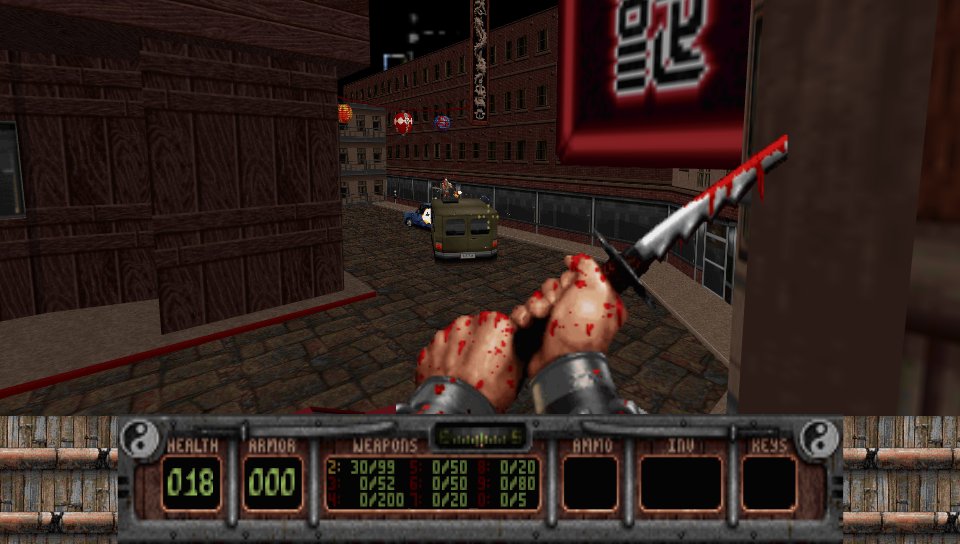
Shadow Warrior was a 'cousin' of sorts to Duke Nukem 3D in so far as it was another 3D Realms Build Engine powered FPS game with a wisecracking protagonist. Lo Wang was every bit the 80's/90's misogynistic action hero Duke was but never achieved the status Duke had. That said the Shadow Warrior franchise continues to this year when in March a second sequel of the rebooted franchise released while the Duke was put on ice after the legendarily delayed and phenomenally shit  Duke Nukem Forever released in 2011.

The setting of the original game in 1997 was near future Japan and Lo Wang was the ninja employed by the Zilla corporation to protect its interests. However after Zilla began to wrest power from organised crime and dabble in supernatural forces, honour-bound Lo Wang took it upon himself to single-handedly bring down the corporation with a hilariously mismatched arsenal of both silent and high-explosive weaponry. In honour of it's 25th Anniversary, I said before the year was out I'd crank up Shadow Warrior for a few hours and just give myself a little injection of nostalgia.

Shadow Warrior, Duke Nukem 3D, Blood and Redneck Rampage to name but a few shared one of the more ubiquitous game engines of the mid to late 1990's, the Build engine. It's considered more a 2.5D engine as geometry is two-dimensional with added height and renders the world in a way that only seems three-dimensional, unlike modern engines that create actual 3D environments. Enemies and pickups are 3D voxels and simply animated unlike 3D characters. By the time Shadow Warrior actually released, Id Software had a year earlier brought the first true 3D FPS engine to the market with Quake and Build was woefully outdated by comparison. However Quake was only one game, whereas it would take developers a few years to master the true 3D environment, Build developers released fun games like Shadow Warror to fill the gap. Unfortunately when you're in a Build engine game today after playing modern engines for the past 25 years, one notices that the perspective tricks that Build used to project a 3D environment sadly don't work visually and can be disconcerting.

The game itself, while obviously a DOS game, benefits from the likes of DOSBox or other modern implementations to get it working on today's systems, and the results were satisfactory. I initially loaded the GOG Shadow Warrior Classic version as it's free. Sadly it restricted me to a low resolution using half the monitor and with no ability to change the controls to WASD/Mouselook, the FPS control system of today. Thankfully however there is a simple solution to this, VoidSW a DukeNukem Sourceport also supports Shadow Warrior and with it enabled I soon had a DirectX version of Shadow Warrior running at native 21:9 resolution with rebind-able controls.

An average play-through of Shadow Warrior would take about 14 hours, time which I knew I couldn't spend but I played enough to remember the good old days where games like this took less time to develop and would run great new even older hardware. Shadow Warrior benefited from the developers comfortability with Build after Duke Nukem 3D and it showed though the superior level design taking it to the max. In the couple of hours I did play I only encountered some of the game's basic enemies and collected about half of the weapons in Lo Wang's arsenal. I forgot how ridiculous the level of gore was although it was comically rendered, it left little to the imagination and tremendously excited myself at the time.


Final Verdict: Shadow Warrior is a minor classic but very much a product of it's time. I think it's harder to play and look at today than DOOM is due to the way it forces the 3D perspective to create more realistically shaped environments. The action however is loud, fast and littered with the protagonist's wisecracks and one liners as enemies explode with blood.It was fun for a couple of hours but it's highly unlikely I'll be trying it out again, as with Duke Nukem 3D, I'm happy with the memories I have.

Technicals: 2 hours approx playtime using a Nvidia 3070Ti @ 3440x1440 @ 175Hz with max settings on Windows 11. Windows HDR does not enhance.

Bugs: The standard version of Shadow Warrior does not have modern resolutions nor has options for adjusting keybinding. The VoidSW component of the Eduke32 sourceport however fixes both issues flawlessly..

Shadow Warrior Classic is available from GOG for FREE as in 2016 a Shadow Warrior Classic Redux version was made available for sale on both GOG and Steam.

Franchise Timeline: 

Shadow Warrior [1997]
- Shadow Warrior: Twin Dragon [1998]
- Shadow Warrior: Wanton Destruction [2005]
Shadow Warrior [2013]
Shadow Warrior 2 [2016]
- Shadow Warrior Classic Redux [2016]
Shadow Warrior 3 [2022]

Sunday, December 18, 2022

Retro Review: Quake II RTX [2019]

Note: Quake II was originally released in 1997. The base game was given a facelift by Lightspeed Studios working with Nvidia in 2019 to showcase the value of Nvidia's RTX ray-tracing technology. The latter version is reviewed here.

I honestly didn't ever expect to install Quake II again. It was, superior to Quake in technology as well as setting, fun in its day but is considerably aged looking by now. Yes it's obviously been modded by fans to run in HD with updated textures etc, but id Software have not remastered it as they did with the original. They may not need to now however; After a proof of concept from Christoph Schied and the team at the Karlsruhe Institute of Technology, who added ray tracing to the game, Nvidia got behind a new modification that would serve to transform one of gaming's greatest tech-demos of the 1990's into one for the 2020's. I installed it earlier in the year just to test a new RTX GPU and was well impressed by the enhancements it brought to the game. This coupled with the fact that it is also 25 years old this year prompted me to take Quake II for an anniversary spin before the year was out.

What Nvidia RTX does is it enables real-time ray tracing. This used to be limited to CGI in visual effects for movies or photorealistic renderings for example, while games traditionally had to rely on direct lighting or precaluclated rays. RTX is able to instead, generate interactivity in images that react to lighting, shadows and reflections in real time. Now the GPU processing power required for this is expensive and reflected in the price of the current generation of GPUs but even then the effect is so demanding that it often can't be enabled together with Ultra-high quality graphics on modern games and still maintain a satisfactory frame-rate. Quake II however, is very far from modern and is a perfect showcase for the true power of the technology and what it means for gaming in general.

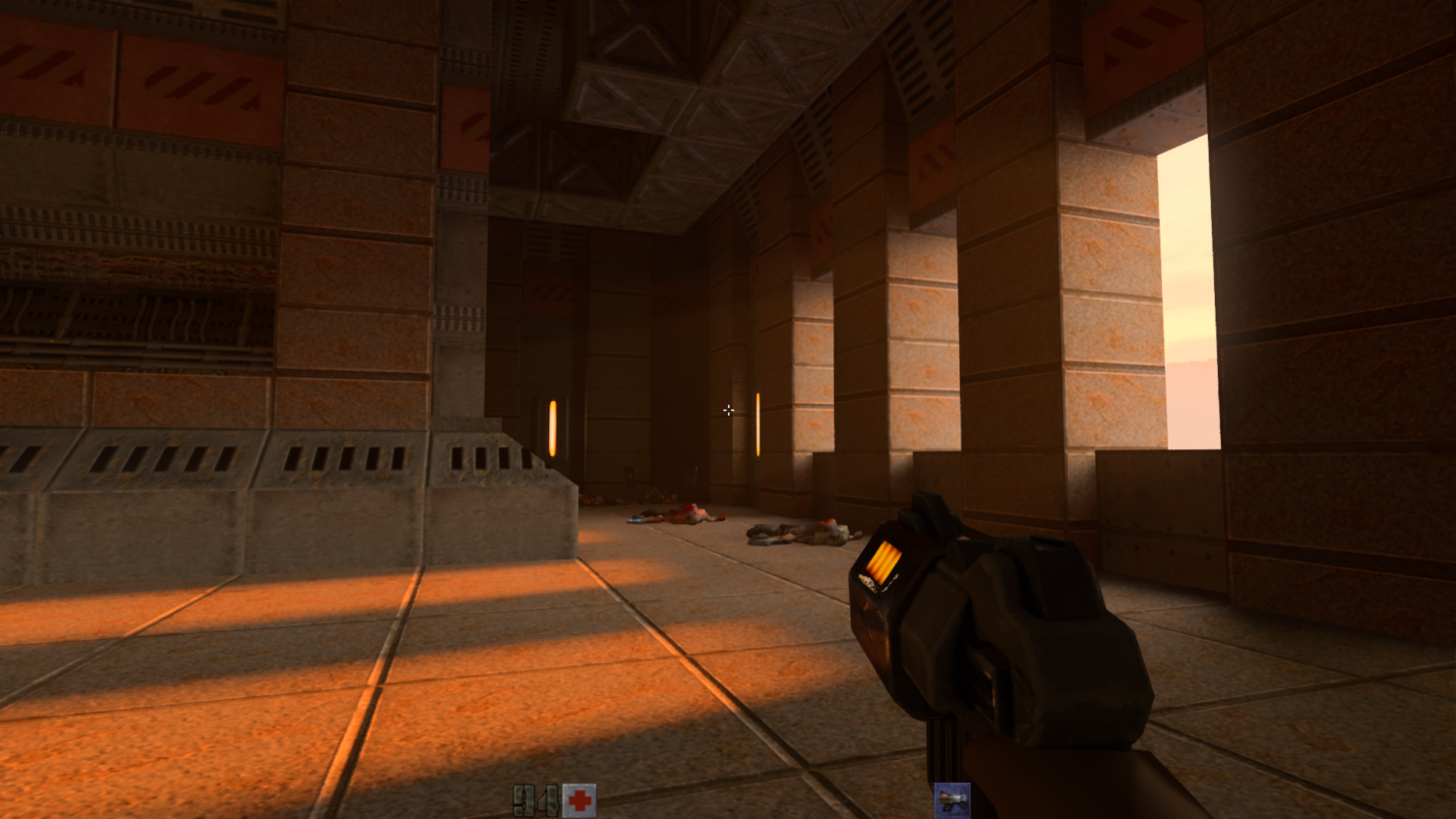
While playing Quake II RTX, despite the levels and some upscaled but dated textures and ancient modelling for enemies and pickups, I did often forget I was looking at a 25 year old game. The lighting and reflection effects were astounding. Your character is reflected as you look at reflective surfaces like computer screens or glass, overhead lighting and effects are reflected in all liquid and there was one sequence in total darkness that created a strobe light effect so realistic that I'm glad I don't have epilepsy. This all looked impressive on an SDR 4K monitor when I sampled it earlier but was even more amazing in HDR during my full play-through.

Quake II was an important step in the history of the FPS. It was one of the first examples of coloured lighting, a revolutionary feature for the time. Additionally the engine was written in such a way that it could be easily modified and marketed to others and it certainly was used for this purpose. Quake II powered classics such as SiN and Soldier of Fortune. Valve even used the Quake II engine to power the first version of Half-Life and although the final GoldSrc engine is more akin to the original Quake engine, GoldSrc still contained some Quake II code. It's fair to say that after John Romero left and beginning with Quake II, id software began producing games that were less about the story and gameplay and more about "tech-demos" showcasing the power of each iteration of their new engines preventing any of their games from reaching the hype Doom and Quake had in the mid 1990's until DOOM in 2016.

Quake II ditched the strange nailgun shooting Lovecraftian horror setting of the original and adopted something they were much more familiar with, shooting abominations with energy and explosive weapons as a Space Marine! Your enemy now was The Strogg, an alien race of cyborg-ish monstrosities that were invading earth, but your mission as a 1990's FPS game hero before AI coded team mates were a thing, is to attack their home world and kill their leader. As one would expect from a glorified tech demo, it was pretty short on narrative but that may be also be one of id's charms.

My initial time with Quake II RTX was brief so it was a thrill now to explore beyond the confines of the free version. The game is expansive was was the norm at the time and as I was more concerned with the visual aspect rather than playing the game I had godmode on half the time during some of the sequences that due to 25 years of advancements in level design and AI, are now too dumb to try to beat normally. It still took over 6 hours to navigate from start to finish and I would estimate a lot longer if going through carefully. In fact I recall one St. Partick's weekend in 1999 I played through the game in about 8 hours in co-op with my friend the late James Dutton. I think he'd approve of the enhancements made to the game today.


Final Verdict: The aged visuals, somewhat confusing level design by modern standards and the lack of compelling narrative even by FPS terms is not enough to play Quake II again. It's just not good enough or worth your time unless you need a hit of nostalgia. Quake II RTX however is certainly somthing that you should investigate if you have the hardware for it. It transforms the game and shugarcoats the aged visuals with some of the tastiest sugar you've ever had. Actually, it can't be sugar, it's cocaine... it's cocaine not sugar. But you must see for yourself.

Technicals:
Case 1: 1.4 hours playtime @ 3840 x 2160 (4K) / 60Hz with max settings and RTX ON. Avg FPS 35,  No HDR
Case 2: 6.1 hours playtime @ 3440x1440 UW / 175Hz with max settings and RTX ON.  Avg FPS 95, HDR settings implimented in game.  
Both cases through Steam using a Nvidia 3070Ti on Windows 11.

Bugs: Pressing F12 for a screenshot crashes the game. Rebinding F12 to another key and using that to screenshot also crashes the game. Not a bug but as Quake II used a CD as it's music soundtrack there is no music in the game. This was easily solved by using .ogg files of the music tracks from the original CD and placing them in a music folder in the game directory.

Quake II RTX is free to download from Steam or GOG and try out on your RTX ray tracing enabled system (it also apparently works with AMD RX series) but only has a few early levels. If you have the full version of the game (again on Steam or GOG) you get the benefit of being able to play through the entire game in the RTX implementation. Quake II is available from both Steam or GOG for €4.99. The Steam Quake II copy to unlock the full version of Quake II RTX for this review was purchased for €1.64 in July 2019.

Quake Series:

Quake [1996]
- Quake Mission Pack No. 1: Scourge of Armagon [1997]
- Quake Mission Pack No. 2: Dissolution of Eternity [1997]
Quake II [1997]
- Quake II Mission Pack: The Reckoning [1998]
- Quake II Mission Pack: Ground Zero [1998]
Quake III Arena [1999]
- Quake III: Team Arena [2000]
Quake 4 [2005]
- Enemy Territory: Quake Wars [2007]
- Quake Live [2010]
- Quake: Dimension of the Past [2016]
Quake Champions [2017]
- Quake II RTX [2019]
- Quake: Dimension of the Machine [2021]


Friday, December 09, 2022

Replay Review: Return to Castle Wolfenstein [2001]

While I enjoyed playing the 1993 version of DOOM a while back, I did so partly because it was one of my first PC video games. It wasn't until after DOOM II in 1994 that I played Wolfenstein for the first time and certainly for not as long. Compared to DOOM it was a bit inferior and I felt it was more interesting killing hell-spawn as opposed to just Nazis. However as the DOOM franchise was stagnant by the turn of the century, I welcomed a new version of Wolfenstein in 2001 as my new FPS for the year, even favouring purchasing it above Halo: Combat Evolved as by then killing Nazis was actually a more novel idea (Return to Castle Wolfenstein predated both the entire Medal of Honor and Call of Duty franchises).

Return to Castle Wolfenstein is a reboot of the Wolfenstein franchise as far as the loose narrative is concerned but employs similar themes including Nazi experiments such as the creation of "Ubersoldats" similar to MechaHitler from Wolfenstein 3D and occult themes including the appearance of the undead as in Wolfenstein 3D: Spear of Destiny. Return to Castle Wolfenstein is set in 1943 and once again follows the adventures of protagonist US Army Ranger William “B.J.” Blazkowicz as he navigates through German castles, secret laboratories and ancient tombs on his quest to thwart the plans of Heinrich Himmler’s German SS Paranormal Division from producing a force that could win them the war. 

Built on the id Tech 3 engine, under producers Id Software, developers Grey Matter who would also later make the first Call of Duty expansion delivered a very well received reboot of Wolfenstein. Despite the horror/sci-fi elements of the franchise they created an experience that was 80% WW2 action movie (specifically Where Eagles Dare) with an action movie score delivered by Bill Brown (Rainbow Six) and with a series of very well crafted levels which, while much too linear by today's standards, were certainly among the most superior examples of level design at the time. The game's weapons were also modelled on WW2 weapons including the British Sten gun and the U.S. Thompson M1 although one is most likely to use German weapons such as the FG-42 rifle much more as you eliminate enemies on your one-man-army romp through the game.

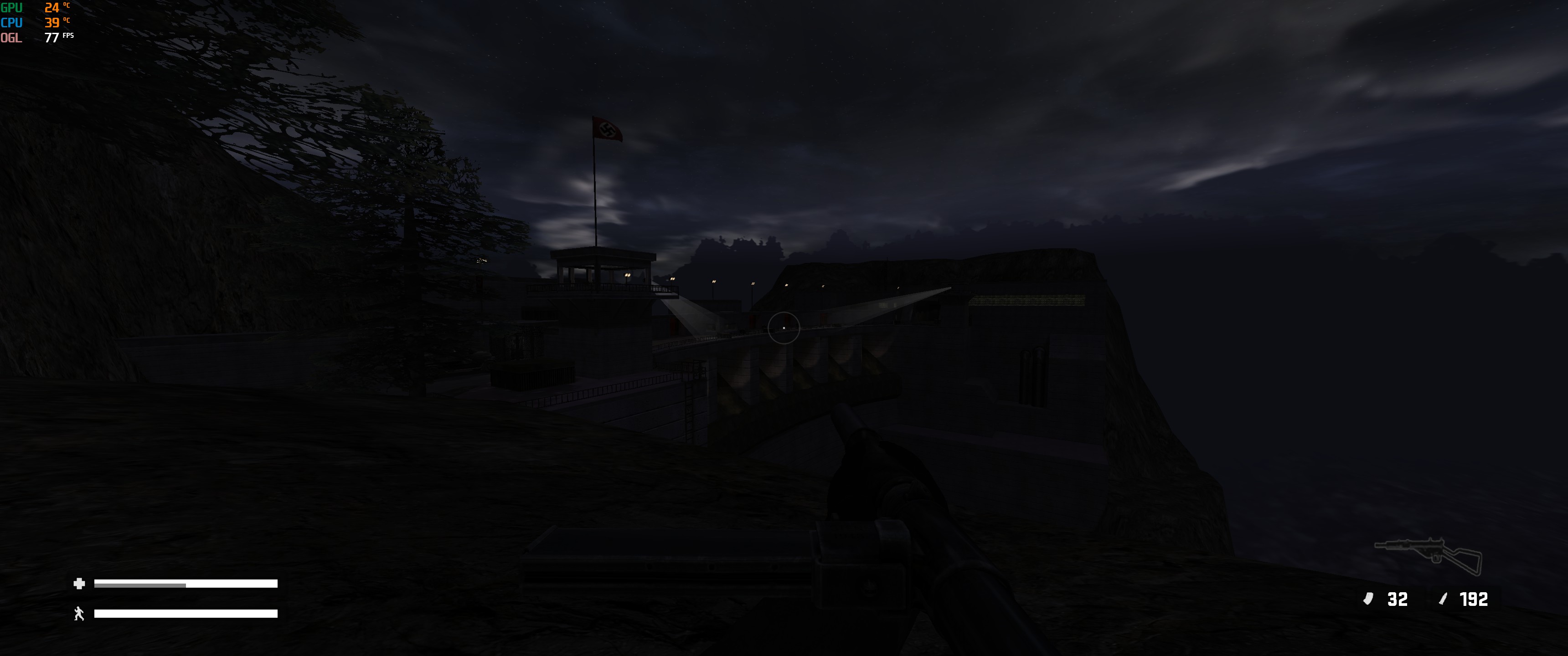
I was all set to experience a blend of action and horror, wielding a combination of classic WW2 and fictional, sci-fi-inspired weapons against Nazis, the undead, and experimental mutant soldiers. Unfortunately the Steam implementation of RTCW is buggered and I was given an OGL error on startup. While there were a series for fixes suggested to get one up and running today, I was also directed to a "RealRTCW" a community made Steam mod that not only allows the 20+ year old game run on current state-of-the-art systems, but also in ultrawide resolutions and with a plethora of graphical upgrades. It does make changes to some in-game elements adding several era-appropriate weapons and some combat rebalancing which I felt were worthwhile additions and reduced some annoyances that are common with playing such an old game, but a more vanilla experience exists retaining only the graphical upgrades is available for those who need it. RealRTCW seemed like a no-brainer and its install and setup was as you'd expect from the main game. While a separate entity, the game requires RTCW registered to Steam to avail of it.


Final Verdict: A solid shooter with varied narrative objectives. Despite the sci-fi/horror elements, which are present but not oppressive, the vast majority of the game is a quasi-realistic depiction of "Hollywood Style" WW2 combat and strangely was the most accurate WW2 FPS experience in Multiplayer at time of release. It sits right in the middle of one of the oldest game franchises today which is still beloved and going strong, a testament to how the genre of "alternative" WW2 depictions have intrigued fans for decades.

Technicals: 11.2 hours playtime through Steam using a Nvidia 3070Ti @ 3440x1440 @ 175Hz (capped at 77FPS) with max settings on Windows 11. Windows HDR auto-activated and provided an expected amount of superior lighting.

Bugs: The standard version of Return to Castle Wolfenstein would not initialise after setting  a resolution other than 1024x768 citing an OpenGL error. full ultrawide support with no bugs was delivered through the RealRTCW mod.

Return to Castle Wolfenstein is available from Steam for €4.99 or GOG for €6.19 when not in a sale. Steam recommended for the RealRTCW patch. Review copy purchased from Fanatical for €2.39 in March 2021.


Series:

  • Castle Wolfenstein [1981]
  • Beyond Castle Wolfenstein [1984]
  • Wolfenstein 3D [1992]
  • - Wolfenstein 3D: Spear of Destiny [1992]
  • Return to Castle Wolfenstein [2001]
  • - Wolfenstein: Enemy Territory [2003]
  • Wolfenstein [2009]
  • Wolfenstein: The New Order [2014] 
  • - Wolfenstein: The Old Blood [2015]
  • Wolfenstein II: The New Colossus [2017]
  • - Wolfenstein: Youngblood [2019]
  • Wolfenstein III [?] 

Sunday, November 27, 2022

First Play Review - Sniper: Art of Victory [2008]

I heard good things about Sniper: Ghost Warrior 2 even as a relatively lower budget game than I'm used to and was waiting for it to go on sale to purchase. I was fortunate enough to get it and it's two predecessors Sniper: Ghost Warrior and this game bundled together for €0.95. While I'm not expecting much from Ghost Warrior, I was expecting even less from the very first game in Polish outfit City Interactive's long running series. I do look at other reviews for games before I buy them just to get a vibe but as this was essentially 32 cents, I simply installed and tried it before reading anything.

What was not promising was wherever video intro technology being used to display the opening logo or cutscene didn't show for me. I heard the narration but I got a 1024x768 blank screen before the main menu. Not a good start, but the game was made for Windows XP so... Changing the resolution involved editing a config file in the game's directory. Once that was done I was on the right track and I can safely say I has no other technical issues beyond that. All the issues I did have were with the gameplay itself.

Sniper: Art of Victory is clearly a low budget FPS which favours the sniper rifle as the base weapon and puts you in the shoes of a Red Army sniper tasked with various missions on the Eastern front in WWII. The graphics would have already been dated looking in 2008 when compared to the likes of Far Cry 2 or Battlefield: Bad Company 2 that were released in the same year. City Interactive however, were only just then trying to level up from the bargain bin low budget games tier at the time of release so I was willing to ignore graphics if the gameplay was good. Spoiler alert: It wasn't!

The actual sniping was neat enough, the game takes account of wind, your breathing, bullet drop etc. which is certainly not the norm in most FPS. Unfortunately the enemies you are actually shooting at are are what ruined the experience. The AI was shockingly bad, they were either dumb as a brick and stood motionless as shots were going off nearby or they were magically endowed with the power to see you even if you were prone or in cover. I was on board with the fact that you alert a camp full of guards once you fire the first shot, but I was not on board with the entire camp firing accurately on your position (with machine guns that should be relatively out of accurate range) before anyone could have seen your muzzle flash? No! Absolute nonsense! The credits list four play-testers who I must conclude were drunk while testing.

I shot this Kraut several minutes ago...

The sound was generic and passable but the voice work was a shambles. Your character doesn't speak much but when he does your voice is that of an American sounding stock voice artist reading the lines emotionlessly, not even a fake Russian accent attempt. I stuck it out for about 90 minutes before I got stuck in scenery and was then killed jumping off the roof of a shed. Something I've done in real life without injury, but a death sentence for a Red Army sniper apparently.

There was only a handful of good shooters out in 2008. Far Cry 2, Battlefield: Bad Company 2 and Call of Duty: World at War. Actually I didn't even play World at War because I was still playing some Crysis, Half Life: Episode 2 and Call of Duty: Modern Warfare from the previous year. All games mentioned I have and will gladly play again today. But if Sniper: Art of Victory had somehow found it's way to me then I can safely say I wouldn't have been installing it today.

Final Verdict: An interesting idea that was seemingly done better three years earlier by Rebellion with Sniper Elite. Just because this can still be played doesn't mean it should be. So don't. Ever!

Technicals: 1.5 hours playtime through Steam using a Nvidia 3070Ti @ 3440x1440 @ 175Hz with max settings on Windows 11. A DirectX 8 game, it forces 60FPS as a cap. Windows HDR provided no enhancement.

Bugs: Blank screen on startup until menu. Resolution needs to be manually edited in config. AI is just incompetently coded as opposed to bugged.

Sniper Art of Victory is only available from Steam for €2.99 when not in a sale. Review copy purchased from Fanatical (with both Sniper: Ghost Warrior and Sniper: Ghost Warrior 2) for €0.95 in December 2018.

Series:

  •     Sniper: Art of Victory [2008]
  •     Sniper Ghost Warrior [2010]
  •     Sniper: Ghost Warrior 2 [2013]
  •     Sniper Ghost Warrior 3 [2017]
  •     Sniper: Ghost Warrior Contracts [2019]
  •     Sniper: Ghost Warrior Contracts 2 [2021]

Tuesday, November 15, 2022

First Play Review - Heavy Rain [2020]

I played Quantic Dream's Fahrenheit in 2005 introducing me to a very different style of adventure game where cinematic storytelling was the focus rather than pointing and clicking. Despite being a french outfit I granted a pass to Quantic Dream created for what it was. Later in 2006 I recall being awed by the reveal of the tech for their new game called Heavy Rain. Producer David Cage gave interviews explaining his technology and motion capturing efforts drumming up tremendous excitement. Sadly it was later revealed that the new game was going to be a PlayStation3 exclusive and in 2008 the cover of an issue of EDGE led me to my first of very few cases of console envy. 

By the time Heavy Rain was actually released (after considerable delay) in 2010, the capabilities of the PC had by far exceeded those of the game and I enjoyed a far superior catalogue than any console but I had enjoyed Fahrenheit so much that I did for a time consider becoming a PS3 owner. However the ROI was deemed too negligible to get a console for a single game even one that was getting the press and accolades. It would be another eight years before it was revealed that Quantic Dream would release Heavy Rain and the studio's subsequent games for the PC. However there would be an additional delay as the initial PC release was limited to the hideously substandard Epic Games Store platform for a year, netting Quantic Dream another round of "exclusivity backhanders." But it was OK, I had waited for nine years and as I'm only playing it now, I actually waited for twelve.

Much like it's predecessor Fahrenheit, Heavy Rain is a cinematic story-driven adventure game with QTE actions and choices that determine how the story unfolds. Quantic Dream pushed the boundaries of character modelling for the age and with significant motion-capture development it has the production quality of a movie with it's camera views and angles, high quality voice acting and a Hollywood class score delivered by the late Norman Corbeil who also contributed to Fahrenheit.

While not named, Heavy Rain's setting is a bleak urban industrialised area of Philadelphia and as it's name suggests, is rains significantly as if to punctuate how depressing life is for it's despondent inhabitants. The plot is centered on four characters which you control through various scenes and take part in their lives as they intersect a police investigation into "The Origami Killer", a serial killer who preys on young boys by drowning them in rainwater leaving origami figures at the scene. We follow Ethan (Pascal Langdale - Killjoys) a family man whose life is shattered when one of his sons is killed in an accident and later his remaining son is kidnapped by the killer. Scott Shelby (Sam Douglas - Snatch) a P.I. perusing his own investigation. Norman Jayden (Leon Ockenden) an FBI profiler assisting the police with their investigation. Lastly Madison Page (Judi Beecher [voice] - Taken 3 and Jacqui Ainsley [model] - King Arthur: Legend of the Sword) an insomniac journalist  who becomes embroiled with the investigation.


What annoyed me about Fahrenheit is that the story fell apart when it introduced the prophecy and the supernatural elements, distorting what was shaping up to be a fine psychological thriller. Such mistakes are not repeated here and the game is firmly rooted in realistic drama that slowly unveils the root of human madness - or plain evil depending on your own views. While it's fair to say the story is significantly better than Fahrenheit's, it's clear from the construction of the narrative that David Cage is not the best writer when it comes to plot holes. While he nails the drama and emotional intensity of a scene; the technical issues in constructing a believable story without some gaping plot holes are sadly beyond Cage's reach. The most egregious and largest amount of issues by far are the almost complete incompetence on the part of the police. Granted some of them are corrupt but the way they are portrayed in the game as so inept they make Frank Drebin look like Columbo. Plot holes and dumb plot elements are fine in something like an FPS but in a narrative-driven game they can be distracting. To be clear these issues don't ruin the game but prevent it from being a masterpiece of interactive storytelling.

Much more improved upon from it's predecessor is the control system of Heavy Rain, some of which was apparently borrowed from Shenmue. Deft mouse movements as you press and hold your mouse to create patterns as well as quick snap clicks of associated keys are used here instead of the somewhat awkward "Simon Says" colour-coordinated gameplay of Fahrenheit. Unlike it's predecessor the game is much more forgiving for mistakes, you need to do certain sequences again if it's a necessary plot point but often you just might need to live with the failure and carry on with the 'failed' state into a different branch of the story than you would have had had you passed the QTE trial. This mechanic is a much more interesting way of presenting the content as success, failure or even inaction can produce different consequences making the story not only adapt to your choices but also your skill.


As documented in my review of Aspyr's port of the Fahrenheit remaster, that port was deeply flawed with  an initial inability to launch as well as progress-debilitating save-file corruption. Heavy Rain by comparison is technically flawless having been ported by Quantic Dream themselves and ran without a single issue on Windows 11 save for it not adapting to 2:9 resolution, keeping 16:9 even when the former is selected. It's engine performs admirably and it's visuals are superior to the original, having received some class of remaster itself for the PS4 in 2016 which was then carried over to the PC port.

Final Verdict: A deeply atmospheric, emotional and suspense filled adventure that had some remarkable twists and turns depending on your choices and actions (or inaction). While the story is flawed, the game's technical presentation, music, incredible voice acting and one's connection to the characters overshadow any faults with the plot. In Heavy Rain, success was achieved in pushing the boundaries of interactive cinematic storytelling and cemented Quantic Dream as masters of the genre. 

DLC: None

Technicals: 9.1 hours playtime through Steam using a Nvidia 3070Ti @ 3440x1440 @ 175Hz with max settings on Windows 11. Game capped at 60FPS and forced to 16:9. Win 11 HDR provides satisfactory enhancement.

Bugs: None.

Heavy Rain is available from Steam for €19.90 with significant sales occasionally. Reviewed copy purchased from Steam in 2020 for €8.16.

Quantic Dream releases (PS3/Console)[Steam/PC]

Wednesday, November 02, 2022

First Play Review - Metro 2033 Redux [2014]

Note: While Metro 2033 was released by THQ in 2010, Deep Silver later released a Redux (enhanced) version. The latter release is reviewed here.

In 2010 Ukrainian studio 4A Games turned Russian science-fiction writer Dmitry Glukhovsky's most famous novel Metro 2033 into a much lauded single-player first-person shooter. The game is set in the underground Metro tunnels of a Moscow which has been almost utterly destroyed by nuclear war. You play as one of the Metro's inhabitants who must brave the perpetually dark tunnels and sometimes harsh winter of the surface as you evade or kill both enemy factions and mutated beasts. As opposed to a military science-fiction shooter as one might suspect, the game falls instead into the category of survival-horror. It's really the worst kind of genre as I generally hate the idea of "ammo conservation", "environmental death" and "jump-scare-enemies". While certainly normally not my thing I decided to at least attempt to play by the rules, and see what 4A Games produced, especially as the series has progressed to a trilogy (thus far).

Following 4A's initial success with the game in 2010, they released a sequel Metro: Last Light in 2013 featuring significant graphical and gameplay improvements. Some of these improvements were then retroactively applied to the original Metro 2033 and 4A created a superior version of both games called Metro Redux the following year in 2014. Naturally I installed the Redux version of Metro 2033 and was greeted with a stable platform with a superior graphical fidelity augmented by Windows 11 HDR.

The central narrative, as with most FPS isn't considerably complex. As Artyom a young inhabitant of Exhibition, one of the underground areas humanity has claimed, you are tasked to bring an important message to Polis, capital of the Metro. You embark on a fairly linear path through the dank tunnels, collapsing walkways, monster ridden sewers and sometimes the even deadlier topside. The game is very atmospheric, everyone speaks English but in their native accents, everything feels broken and filthy, lighting is used to phenomenal effect and you rarely feel alone for long due to a plethora of NPCs you encounter along your route. Listening to others talk earns you hidden humanity which may effect the outcome of the game, much of the NPCs stories are most critical of modern Russia, but satire is not the focus of the game, it simply adds flavour.

Thankfully the game does not seem to fully embrace the harsher survival horror tropes of the genre. This is partly because the "Spartan" difficulty mode was ported into Metro 2033 from Metro Last Light. In this mode one is given greater resources and movement speed as opposed to the default play style of the original version of the game which by all accounts seemed more difficult such as having a less forgiving environment and less equipment and ammunition to collect. I did conserve a lot of ammo in the first half of the game but I became a little more trigger-happy as it went on as I got used to the amount of ammo one picks up with simple exploration.


AI is not the best here and there are not a significant variety of enemies, with some appearing in only one or two small areas of the game. There are not really jump scares or such nonsense but fear and apprehension is forced with the use of sound. When sound stops you know you've killed everything. Weapons are interesting; there are standard "pre war" weapons such as revolvers and Kalashnikovs but many weapons are bastardised makeshift weapons that have been put together from components of other devices such as gas-operated ball-bearing weapons. You can only carry three, so the tactic of picking up something that has more ammo than what you're holding can be used frequently.

There was one stand-out level partway through the game where you have have cross over (or under) a bridge - each side guarded by an enemy faction... who are also against each other! While many of the levels were unique even to a veteran FPS player, this seemed extraordinarily well designed and could be traversed differently, a stealth route under the bridge or a "loud" route across it. I completed one side by popping off each member of the enemy faction on one side with just a silenced pistol. Then I collected all their ammunition which I used on a crazy frontal assault to the other side. It wasn't the only time interesting choices were presented in an otherwise strictly linear game which was a nice touch.

The only issue I encountered during gameplay was a couple of times on the surface - where you must wear a gas mask or die from the poisoned atmosphere - was that I ran out of gas mask filters while exploring for ammo and ironically, more gas-mask filters! The first time it happened I had to replay a significant portion back beyond a number of autosaves to the beginning of the level so I could change my gas mask filter replacement and conservation strategy to have enough to finish the level. The second time it happened I enabled a cheat to put no time limit on the filter. Replaying sequences due to not having resources available wasn't something I was interested in doing. Other than this minor issue the game was great.


Final Verdict: The survival horror genre attached to this game put me off for years, but it's not nearly as harsh as the genre suggests in this Redux version. You have plenty of ways to see by flashlight, petrol lighter and even night-vision goggles. Ammo and equipment was more plentiful than in some WWII shooters so this is certainly a very light implementation of survival-horror, something which will make me less apprehensive now about the sequel Metro: Last Light that I will experience at some point in the future.

Technicals: 12.5 hours playtime through Steam using a Nvidia 3070Ti @ 3440x1440 @ 175Hz with max settings on Windows 11. As a Direct X game, it activated Windows HDR and this provided an unexpected amount of superior lighting.

Bugs: No bugs of note.

Metro 2033 Redux is available from Steam or GOG for €19.99 when not in a sale. Review copy purchased from Humble Bundle (with Metro: Last Light Redux) for €5.69 in December 2019.

Series:

  • Metro 2033 [2010]
  • Metro: Last Light [2013]
  • - Metro Redux [2014]
  • Metro Exodus [2019]
  • - Metro Exodus (Enhanced) [2021]